Nassau County
Gold Coast estates, the Levittown-era Cape and split-level belt, and the Uniondale & Mineola commercial corridors.
Nassau and Suffolk are detached houses with driveways, office parks with surface parking, and apartment buildings clustered around LIRR stations. Almost none of it has a riser you can pull a new intercom cable through.
In a pre-war Brooklyn walk-up the vertical pathway already exists. Somebody cut a chase in 1926 and every contractor since has used it. That is the whole reason a six-story building can get a new video intercom in two days.
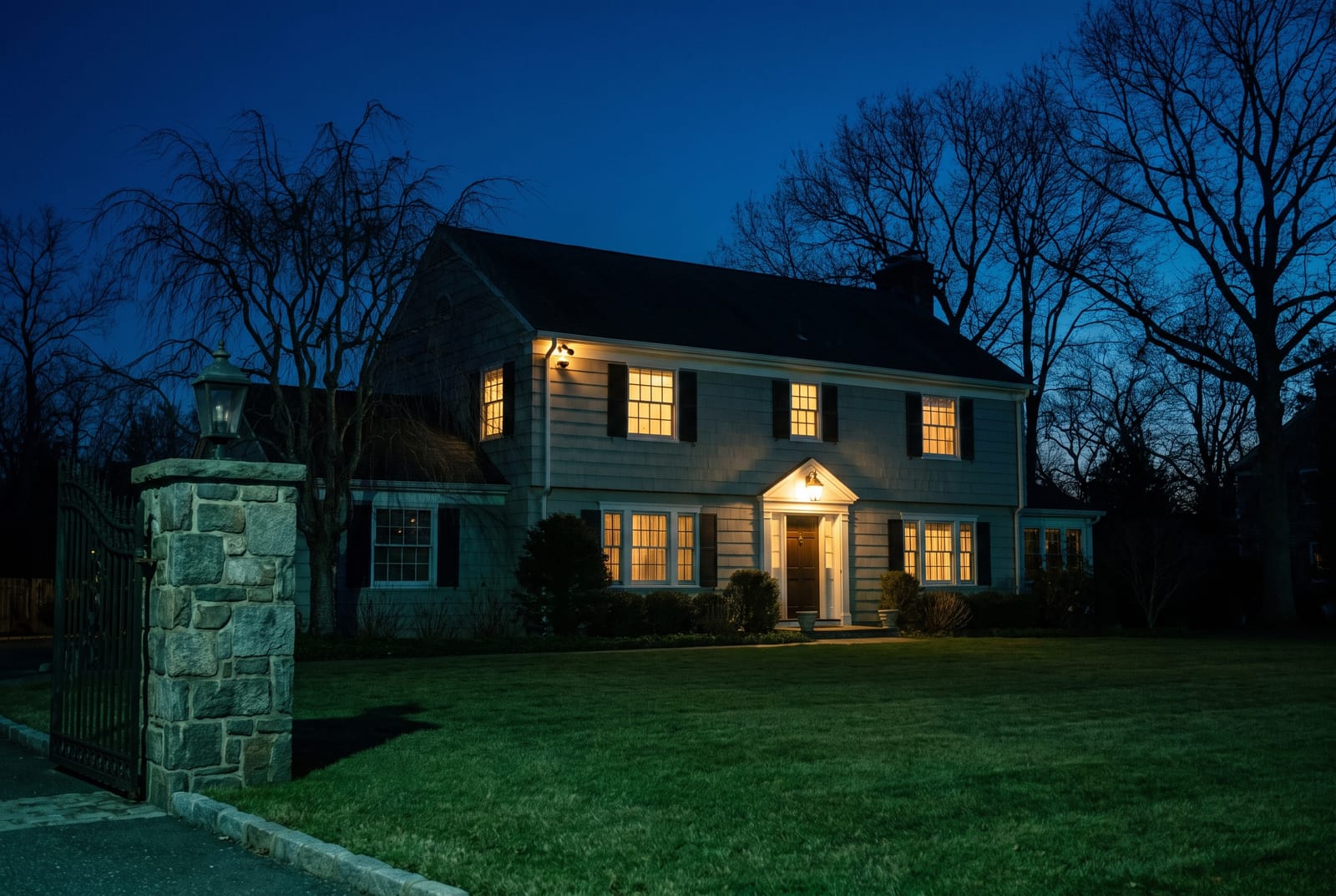
The Long Island equivalent is a 1954 split-level or a Cape from the Levittown era. There is no chase, no conduit, blown-in insulation in the exterior walls, a finished basement ceiling and a garage that was converted into a den in 1987. The pathway is the attic, the soffit, the garage wall and the outside of the house, and every one of those has a different cost, a different weather exposure and a different chance of the homeowner seeing the cable afterward.
That is what actually moves the price on a suburban job. The hardware is the easy part. A camera on the far corner of a detached garage can be a 180 foot run before you have left the property, and a Cat6 channel carrying PoE stops working reliably at 328 feet. So the first question on a Long Island house is where the switch and the power supply live, not which camera goes on the quote.
None of these come up on a Manhattan lobby job. All of them come up weekly on Long Island.
Two counties, roughly 2.9 million people and about 100 separate building departments between them.
Gold Coast estates, the Levittown-era Cape and split-level belt, and the Uniondale & Mineola commercial corridors.
Hauppauge and Route 110 industry, the Ronkonkoma and Patchogue apartment pipeline, and East End estate work.
793,000 people, 22 villages and 39 hamlets: three completely different security markets in one town.
Franklin Avenue and Seventh Street professional suites, plus the Old Country Road retail and office corridor.
Nine villages on one peninsula: Middle Neck Road co-op towers and waterfront estates two minutes apart.
Dense barrier-island co-op and rental stock, boardwalk commercial, and hardware that has to live in salt air.
Office and industrial. The Long Island Innovation Park at Hauppauge holds roughly 1,650 businesses and more than 55,000 employees across 13.9 million square feet of industrial and R&D space plus 3.1 million square feet of office. The Route 110 spine through Melville, East Farmingdale and Huntington Station carries the corporate headquarters cluster. On the Nassau side, RXR Plaza in Uniondale is 1.1 million square feet in two fifteen-story towers, and Northwell Health is headquartered in New Hyde Park. These are low-rise campus buildings with surface parking, which means perimeter gates, multiple badged entries per building, loading docks, and a card population that turns over constantly.
Retail. Roosevelt Field in East Garden City opened in 1956 and now runs 243 stores. The tenants inside it, and the strip retail along Old Country Road, Jericho Turnpike and Sunrise Highway, buy the same three things: a back-of-house door that only staff can open, cameras that actually identify a face at the register, and a stockroom that is not on the same credential as the front door.
Apartments. Long Island’s multi-family growth is concentrated around LIRR stations. Station Yards at the Ronkonkoma Hub is a $1.2 billion, roughly 50-acre development that will reach 1,450 units; Patchogue’s Carriage House adds 262; Mineola approved an $85 million transit-oriented building of 119 apartments. New construction is where the whole building gets specified at once (lobby video entry, fob or phone credentials, garage gate, package room, elevator restriction) and where the person to talk to is the general contractor or the developer, not a resident.
If you are managing a portfolio across both counties, the practical problem is not the hardware. It is that eleven buildings ended up with nine different intercom brands and no single list of who holds a credential. That is a fixable problem, and it is usually fixed one building at a time on a replacement cycle rather than all at once.
How we schedule Long Island
We work regular business hours, Sunday to Thursday, plus Friday mornings. Standard site surveys anywhere in Nassau and Suffolk are free.
Geography is real, though, and pretending otherwise wastes your day. Western and central Nassau and Suffolk we schedule normally. The East End (Southampton, East Hampton, Montauk, the North Fork and Shelter Island) we schedule in blocks, so a survey out there may wait a few days for the next run east. We will tell you that up front rather than book a window we cannot keep.
Both counties, from the Queens line to Montauk Point and Orient. What changes is scheduling, not coverage. Nassau and western and central Suffolk get booked like any other job. The East End and Shelter Island get grouped into runs, because a single service call to Montauk is most of a working day in the truck.
If you are on the East End, the honest advice is to bundle. Survey the gate, the driveway cameras, the pool house and the caretaker’s credential in one visit and have us come back once to install, rather than three separate trips for three small items.
Yes, but the method depends entirely on the distance. A Cat6 channel carrying PoE is limited to 100 meters (328 feet), and that is the whole channel including patch leads, not just the horizontal run. Plenty of Long Island driveways are longer than that once you route around a lawn instead of straight through it.
Past that limit the honest options are a fiber run with a media converter and a small local power supply at the gate, a hardened switch in a weatherproof enclosure partway down, or a wireless link if the sight line is genuinely clear. What we will not do is run 400 feet of Cat6 and hope, which is the usual reason a gate camera works in the spring and drops out every afternoon by July.
It is almost always real. Since 2016, UL 325 requires the external entrapment-protection devices (the photo eyes and the contact edges) to be monitored by the operator. If the operator detects a fault in one, or does not see it connected at all, it will not run. That is the standard working as intended, not a broken gate.
The common causes are mundane: a spider web or road film across the eye, a lens knocked out of alignment by a landscaper, water in the sensor housing, or a rodent through the low-voltage wire. What a legitimate contractor cannot do is jumper the sensor out to make the gate move again. That was normal practice on pre-2016 equipment and it is not an option on current operators, nor should it be.
The copper line went away. Telephone-entry panels dial a real phone number and expect real analog call progress and DTMF tones. When the line is converted to VoIP, the adapter often compresses or transcodes those tones. The typical symptom set is exact: the panel dials fine, the resident’s phone rings, they answer, and pressing 9 to release the gate does nothing at all.
Three fixes exist. The cheapest keeps your existing panel and adds a cellular communicator that presents a simulated dial tone to it, which is the same trick used to keep old alarm dialers alive. The middle option is verifying DTMF passthrough with your carrier, which sometimes works and sometimes cannot be made to. The permanent fix is a native cellular or IP entry station that never needs a phone line at all, which is also what lets you answer the gate on your phone from anywhere.
It depends on the municipality, and Long Island has an unusual number of them: two cities, three towns and 64 villages in Nassau; ten towns and 32 villages in Suffolk. Each village runs its own building department, so two houses a block apart can sit under different desks. Straight low-voltage signaling and communication work frequently falls outside a permit requirement, but that is a local determination, not a blanket one.
What is always true is that any line-voltage side of the job (a new circuit for a gate operator, a dedicated receptacle for a head-end) is licensed electrical work and gets handed to an electrician. We coordinate it; we do not perform it. Outside New York City you are also under the New York State Uniform Code, which references a different edition of the National Electrical Code than the city does, and that can change which cable listing an inspector expects to see.
Usually yes, and it is worth asking before defaulting to wireless. On a Cape or a split-level the attic and the garage are the two pathways that almost always work, and a run down an exterior wall inside a rigid conduit painted to match is far less intrusive than people expect. Where we genuinely cannot get a wire without opening finished plaster, we will say so and price the wireless alternative honestly, including the part nobody mentions: battery-powered devices need batteries changed, on a ladder, forever.
The place we push hardest for wire is anything that has to be reliable at night on a schedule: the front door station, the driveway camera, the gate. Convenience devices inside the house are a much easier place to accept a radio link.
Vehicle gates, garage doors, parking control and the loops and safeties that go with them.
New IP camera systems for buildings, storefronts, offices and homes.
Townhouses, brownstones and single-family homes on Long Island and in Westchester.
Installation, repair and replacement of entry intercoms, from a six-unit walk-up buzzer to a 200-unit IP video system.
Complete door-control systems, from a single door to a multi-building portfolio.
Cat6/6A and fibre backbones, racks, patch panels, certified and labelled.
Driveway length, gate brand, panel model, how many doors. That is usually enough for us to tell you over the phone whether this is a survey or a service call.
Sun to Thu 9am to 5pm · Fri 9am to 12pm · Sat closed