Manhattan work is elevator work, board work, and landmark work
Seventy-seven percent of Manhattan’s housing units sit in a building with an elevator: about 712,000 of them. That single number decides most of what an access control job here turns into.
The densest county in the country, stacked vertically
913,926 housing units on 22.66 square miles. Only about 14% of them sit in structures of one to five units. On Staten Island that figure is 75%.
Manhattan is where the vertical circulation is the security problem. In a walk-up, controlling the front door controls the building. In a 22-story elevator co-op, controlling the front door controls the lobby, and then a visitor who got past it can stand in a cab and press any button on the panel. Floor restriction is not a luxury feature here; it is the thing the front door does not do.
The other Manhattan number worth knowing is vacancy. At 10.5% it is the highest of the five boroughs, and Manhattan is the only borough where vacancy rose between 2010 and 2020, from 9.8%. A large part of that is pieds-à-terre and new inventory in Hudson Yards, Hell’s Kitchen, Murray Hill-Kips Bay and the Financial District. What that means on the ground is a directory with ninety names on it where fifteen units are dark for months at a time, so call forwarding to a phone, package handling and a credential list that gets audited rather than accumulated all matter more here than they would in a fully occupied building in Sunset Park.
Institutional stock is heavy too: 206 NYCHA developments totaling 54,557 units, more separate properties than any other borough, plus 66 Mitchell-Lama properties and 26,104 units. Those buildings buy on procurement rules and standardization, not on a homeowner’s timeline.
What a reader in the cab actually involves
There are two ways to do this and they are not variations on one theme.
Relay-based, which is most of Manhattan. A reader goes in the cab, its output travels down the elevator’s traveling cable to a controller in the machine room, and that controller’s relays sit in series with the floor buttons in the car operating panel so a credential enables only the floors it is entitled to, for a timed window. Entry-level platforms run roughly one controller per four stops; larger boards address far more floors using expansion cards, commonly sixteen floors at a time.
Two things decide whether this is a clean job. First, the spare conductor count in the traveling cable. If the pairs are not there, adding them is the elevator contractor’s scope and the elevator contractor’s schedule, not ours, and that is a conversation to have before anyone signs anything. Second, whether we bring the floor-button outputs back into the access system as inputs. Most integrators skip it. Doing it means the system knows which floor was actually selected, kills the remaining buttons immediately, and gives you a floor-level audit trail instead of a log that only says somebody got in the cab.
Destination dispatch, which is most new Midtown and Hudson Yards towers. There are no floor buttons in the cab at all; the passenger enters a destination in the lobby and is assigned a car. Access control integrates in software over the network to the elevator controller, which is architecturally cleaner and eliminates cab readers entirely, but you are now dependent on the elevator manufacturer’s integration existing, being current, and being licensed. If it does not exist for your equipment, no amount of wiring fixes it.
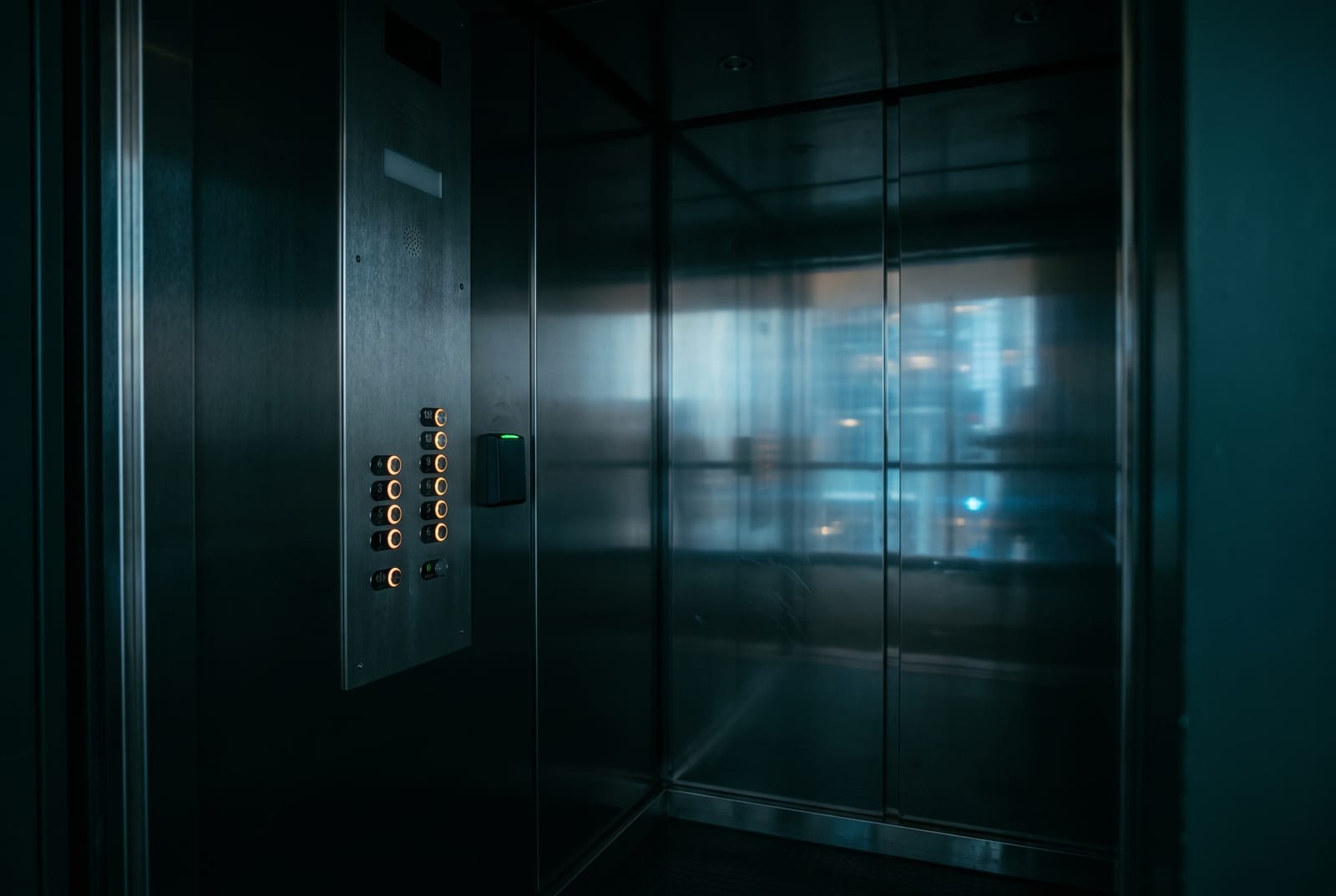
What actually slows a Manhattan job down
None of these are technical. All of them are schedule, and schedule is where jobs in this borough go wrong.
- The board, and the alteration agreement. In a co-op you are working under a contract with the corporation that sets scope, schedule, insurance and the board’s right to refuse. Expect four to eight weeks from first submission to approval once architect review, revisions and certificate-of-insurance corrections are counted. Certificates typically have to name the corporation, the managing agent and often the sponsor as additional insureds, with the endorsements attached rather than just referenced.
- House rules, not our calendar. Most buildings restrict work to weekdays, commonly 9 a.m. to 4 p.m., with no weekends or holidays and a booked service elevator. That is roughly a five-hour productive day once protection is laid and picked up, and it is why a scope that reads like three days is quoted as five.
- The riser is not yours to open. Risers cannot be touched without explicit permission, and in a pre-war building the existing conductors are cloth- or rubber-insulated and crack when disturbed. Opening public-hall walls in a pre-1960 building also triggers lead-paint and asbestos protocols, which is exactly why reusing the existing pair is the highest-value skill in this borough.
- Landmarks, on more blocks than owners expect. Greenwich Village, SoHo-Cast Iron, Tribeca, the Upper East Side, Central Park West and the Upper West Side, Mount Morris Park and Strivers’ Row are all designated. Any street-visible faceplate, camera housing, surface conduit or entry-door hardware change needs an LPC permit before a DOB filing. On a corner building the side elevation counts as street-visible too, which is the detail that catches people out.
- Phased cutover, or a violation. A building cannot go dark on door release overnight. We stage the change so every unit keeps a working release throughout, because a lobby that nobody can be buzzed into is not just an inconvenience. It is the exact condition that generates a housing violation.
- The desk is a system component. Where there is an attended lobby, the access system has to fit how the desk already works: visitor logging, package intake, contractor sign-in against a certificate of insurance, and freight elevator escorting. A platform the concierge will not use gets bypassed by a doorstop within a month.
158,800 units here are still a walk-up
Below the elevator numbers is a tenement belt that runs through the Lower East Side, the East Village, Chelsea, East and Central Harlem, Hamilton Heights, Washington Heights and Inwood: five- and six-story pre-war buildings with a vestibule, a stoop, a 2-wire audio riser installed decades ago, plaster over lath, and no conduit space worth the name.
These buildings almost never need a rewire. A modern IP video entry panel can run over the existing pair using 2-wire-compatible equipment, and even a conventional analog bus system has more headroom than people assume: a common bus platform will run 980 feet from the entrance station on 18 AWG. The catch is the cable specification: manufacturers call for polyethylene-insulated conductors, and standard PVC-jacketed cable has meaningfully higher capacitance that degrades the bus. Pulling whatever is on the truck is the classic way to make a system that works on the second floor and fails on the sixth.
The legal frame matters here as well. New York Multiple Dwelling Law § 50-a requires a Class A multiple dwelling erected or converted after 1 January 1968 with eight or more apartments to have an automatic self-locking door to the lobby, two-way voice communication between each apartment and a person outside that door, and a release the occupant can operate from the apartment. Older buildings are not automatically bound by it, but a retrofit can be required on the written consent of a majority of tenants, which is why so many Harlem and Washington Heights intercom projects begin with a petition rather than a quote.
The practical result in this belt is what people call a virtual doorman: a video entry panel, remote gatekeeping from a phone, and a credential list an owner or managing agent can administer from a browser. It replaces a service that a walk-up could never afford to staff.
Lobbies, turnstiles and tenant credentials
Manhattan holds the largest concentration of Class A office lobbies in the country, and the access problem in them is different again: turnstiles that have to pass a morning peak without queueing, tenant-by-tenant credential administration where each tenant wants to run its own list, visitor pre-registration that produces a credential before the visitor arrives, and freight access controlled separately from passenger.
Street-level retail is its own market and it is enormous. The Grand Central Partnership district alone covers about 9,200 businesses, the Garment District Alliance 6,500, Flatiron NoMad 4,000, East Midtown 3,000, Times Square 2,570 and Chinatown 2,555; further uptown, the 125th Street BID covers 364 storefronts and the Washington Heights BID 246. A storefront needs three things and rarely all three: a camera positioned to give an identifiable face at the door rather than a hat, a back-of-house door that is actually monitored for being propped, and a credential system where a departing employee is revoked in seconds instead of by rekeying.
One more thing that applies to every residential smart-access system in this city, and that almost no national vendor mentions: where a building uses internet-connected entry devices, New York City requires written tenant consent before entry data is collected, limits collection to what the system actually needs, and requires that access records be destroyed within ninety days, and destroyed within ninety days of a resident moving out. That has to be designed in at commissioning, because a platform with no retention control cannot be made compliant later by policy alone.
Manhattan neighborhoods we work in
Forty-five ZIP codes, from 10004 at the Battery to 10034 in Inwood, plus 10044 for Roosevelt Island. Marble Hill sits north of the Harlem River but is administratively Manhattan. We cover it as such.
Below 14th Street
19 areas areas- Financial District
- Battery Park City
- South Street Seaport
- Civic Center
- Tribeca
- Hudson Square
- Two Bridges
- Chinatown
- Little Italy
- Nolita
- SoHo
- Lower East Side
- Bowery
- East Village
- Alphabet City
- NoHo
- Greenwich Village
- West Village
- Meatpacking District
14th to 59th Street
20 areas areas- Chelsea
- Hudson Yards
- Flatiron District
- NoMad
- Union Square
- Gramercy Park
- Stuyvesant Town
- Peter Cooper Village
- Kips Bay
- Murray Hill
- Koreatown
- Herald Square
- Garment District
- Times Square
- Theater District
- Rockefeller Center
- Hell’s Kitchen
- Midtown East
- Turtle Bay
- Sutton Place
Upper East and Upper West
10 areas areas- Columbus Circle
- Lincoln Square
- Upper West Side
- Manhattan Valley
- Upper East Side
- Lenox Hill
- Carnegie Hill
- Yorkville
- Roosevelt Island
- Morningside Heights
Above 110th Street
11 areas areas- East Harlem
- Central Harlem
- Mount Morris Park
- Strivers’ Row
- Sugar Hill
- Hamilton Heights
- Manhattanville
- Washington Heights
- Hudson Heights
- Inwood
- Marble Hill
Common questions
Can you add elevator floor restriction without taking the car out of service?
Mostly, yes. The reader install in the cab and the controller work in the machine room are done with the car available, and the disruptive part is the short window when relays are landed on the car operating panel wiring: usually one car at a time, a few hours each, scheduled with the elevator maintenance company because the car operating panel is their equipment and their liability.
The item that decides the whole schedule is the traveling cable. If it has spare conductors, we use them. If it does not, adding conductors is elevator-contractor scope with its own lead time, and we will tell you that at survey rather than after you have approved a number. In a building with a modern destination-dispatch system there may be no cab work at all, because the integration happens in software.
Our co-op board has to approve this. What do you need to give them?
A scope document written so a board can actually vote on it: exactly which doors, exactly what hardware, what we are reusing, what we are replacing, what happens to the existing panel and directory, how many days of work and inside which hours, and a fixed price with any genuine unknown named as an unknown with a capped allowance rather than buried in a lump sum.
Alongside that, whatever the alteration agreement puts on its checklist: the managing agent’s forms, a drawing where one is asked for, and a work schedule that respects house rules. Plan on four to eight weeks between submitting and starting. Boards meet monthly, architects comment, certificates come back for correction, and the calendar rather than the wiring is what sets your start date.
We’re in a historic district. What are we allowed to put on the front of the building?
More than owners usually expect, but not without a permit. The Landmarks Preservation Commission is concerned with everything visible from the street, including the side elevation if you are on a corner. That covers the intercom faceplate, any camera housing, exterior readers or pedestals, surface conduit, and changes to entry door hardware.
The workable approach is almost always to keep the existing wall opening and change what sits in it, choose a finish and profile consistent with the facade, and route cable internally so nothing new appears on the masonry. Depending on what is being changed, that lands as a Certificate of No Effect or a Permit for Minor Work rather than the far slower Certificate of Appropriateness. We identify which route your job is on at survey, because it is the difference between a few weeks and a few months.
We have a staffed lobby. Do we still need access control?
A desk covers the front door during the hours it is staffed. It does not cover the service entrance, the garage, the roof bulkhead, the stair doors, the package room, the bike room, the laundry, or the elevator itself. In most buildings those are exactly where the losses happen.
The other thing a desk does not produce is a record. When a board asks who was in the building on a Tuesday afternoon, a logbook gives you handwriting and a system gives you a timestamped list. The sensible pattern in an attended Manhattan building is to keep the human at the door for judgment and hospitality, and put the system on everything the human cannot see.
Our fobs are the old thin white cards. Should we care?
Yes. If they are 125 kHz proximity credentials, the generation most New York buildings installed in the 1990s and 2000s, they transmit a fixed number in the clear with no encryption and no mutual authentication. A handheld duplicator costs under twenty dollars, and a documented test cloned one in about fifteen seconds. Retail kiosks in some supermarket chains now copy them for consumers as a convenience.
The migration is undramatic. Multi-technology readers read both the old prox credentials and encrypted 13.56 MHz or phone-based credentials, so you run both for a re-badging cycle and then switch the legacy side off. One caution worth stating: “13.56 MHz” on its own is not a security claim. The chip family and whether the installer changed the factory keys are what matter, and plenty of deployed cards are still running default keys.
Do you cover Roosevelt Island and Marble Hill?
Both. Roosevelt Island, ZIP 10044, is effectively a self-contained community with roughly 14,000 residents, a small number of very large buildings, and its own access and parking arrangements, a much more campus-like problem than the rest of the borough.
Marble Hill is the borough’s odd one out: administratively Manhattan, physically on the mainland next to Kingsbridge in the Bronx, and built like the Bronx: small pre-war apartment houses and one- and two-family homes rather than towers. We scope it against what is actually there, not against its mailing address.
Work that usually comes with this
Elevator Access Control
Floor restriction for co-ops, condos and mixed-use buildings.
Apartment Building Intercom Systems
Multi-tenant systems for 6 to 200+ units, and what MDL §50-a requires of them.
Video Intercom Systems
See who's at the door: lobby panels with cameras, in-unit monitors and phone apps.
Mobile & Cloud Access Control
Phone-as-credential systems with browser-based administration and remote unlock.
Co-ops & Condos
Board-vote timelines, shareholder communication, and phased work that doesn't blow the reserve fund.
Property Management
Portfolio work: one vendor, consistent hardware, COIs on file, documented every time.
Manhattan buildings start with a survey, not a number.
Send the address, the number of units, and what the system is doing now. We’ll walk the lobby, the riser and the machine room and put it in writing before anyone talks price.
Sun to Thu 9am to 5pm · Fri 9am to 12pm · Sat closed