Installing an intercom in a building that was never wired for one
Most New York intercom quotes are really a quote for one of two completely different jobs: reusing the cable that is already in the wall, or pulling new cable through plaster and lath. We establish which one you have before we price anything.
The measurement that sets the budget
Nobody can quote an intercom install from a photograph of the lobby. The number lives in the riser.
The classic New York apartment riser is four-wire: three shared #22 AWG conductors carrying talk, listen and buzz, plus one dedicated selective #22 AWG conductor per apartment. That is why a 60-unit pre-war building has a 63-conductor cable running up the public hall, and why adding a single apartment to an old system is not a software change. It is a pull.
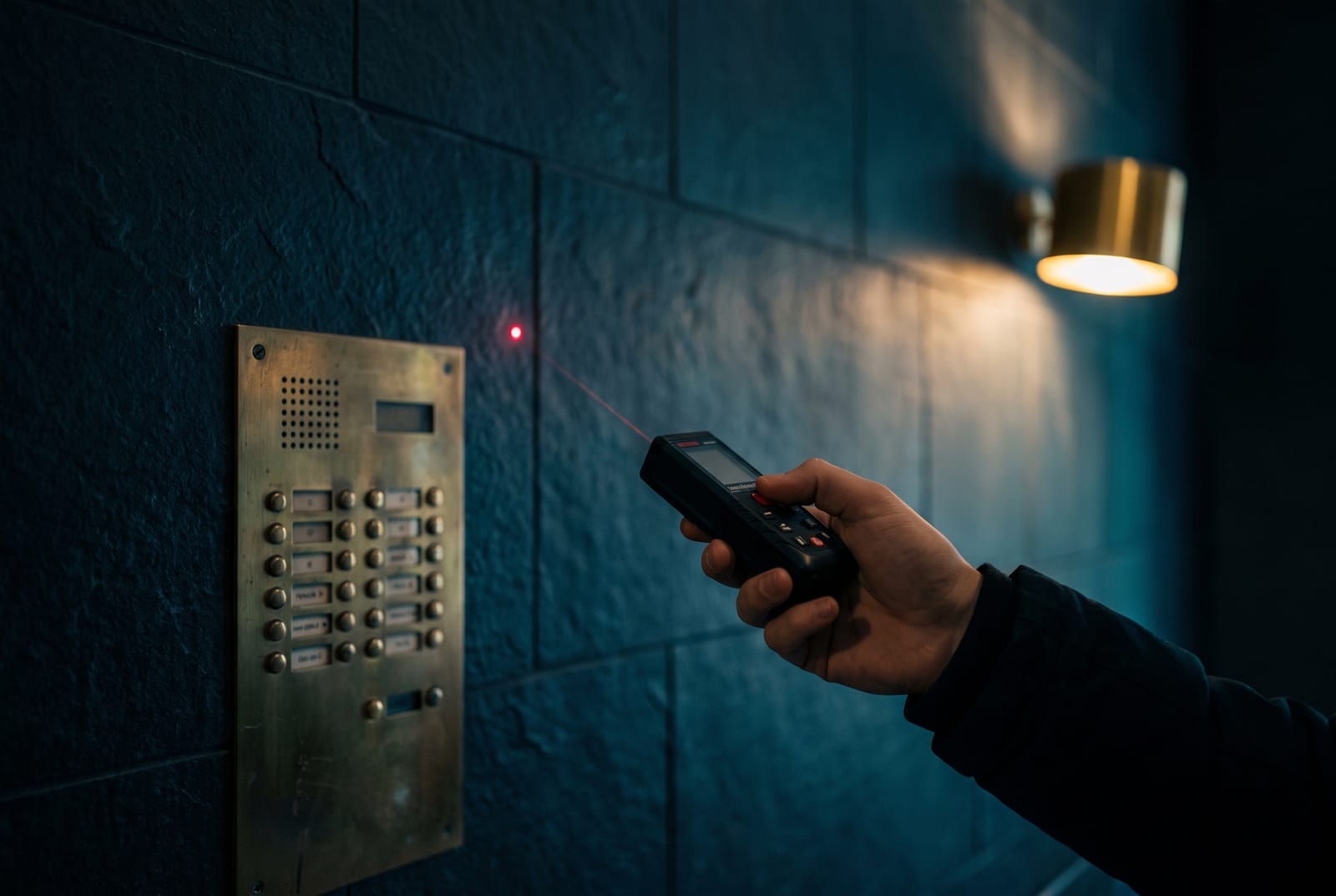
Before we design anything we ring that riser out. We lift it at the distribution point, put a tone on each conductor, chase it with an inductive amplifier, and check every conductor end to end for continuity, for shorts to its neighbors, and for shorts to ground. Then we measure insulation resistance, because a conductor that reads continuous can still be a conductor whose 1926 rubber insulation has gone to dust and will short the first time somebody leans a ladder on it.
What comes out of that hour is a count: how many conductors are usable, how many are already abandoned by previous contractors, and whether the pairs are twisted or just parallel. That count decides whether your new system rides the existing cable or needs a new one, and that single fact routinely changes the total by an order of magnitude, not by a percentage. Any contractor who quotes you a full rewire before checking is quoting for their own convenience.
The same survey establishes three other things that people forget to ask about: whether there is power and physical space at the head-end for a modern controller and a battery, whether the entrance door hardware can actually be locked and released legally, and what the vertical distance is from the lobby to the top floor, because every bus architecture has a hard distance limit and pre-war buildings with tall floor-to-floor heights eat that budget faster than people expect.
Five families, and what each one really costs you
These are not brands. They are wiring architectures, and picking the wrong one is the mistake that produces a beautiful panel nobody can afford to finish.
| Architecture | What it runs on | Where it fits | The honest trade-off |
|---|---|---|---|
| Legacy analog multi-tenant | 3 common #22 AWG conductors plus 1 selective conductor per apartment | Like-for-like audio work in a building whose riser tested sound, or extending an existing system | Cheapest to install and simple to service, but audio only, and parts for several of the old amplifier lines are getting genuinely hard to find |
| 2-wire digital bus | One polarity-insensitive pair carrying audio, video, power and control together | The default retrofit in pre-war New York: video over the pair you already own | Bus discipline is unforgiving: one water-damaged station can load the bus and take audio down building-wide until it is isolated |
| IP over structured cabling | Cat5e or Cat6 home run to each station, PoE, 100 m (328 ft) hard channel limit | New construction, gut renovations, and buildings that already have a cable to every unit | Best feature set by a distance, but it needs a switch, a UPS, a real network and a cable to every single door and apartment |
| Cloud, mobile-first | One panel, one network drop, no apartment riser at all | Buildings whose riser is dead and cannot be replaced without opening finished walls | Removes the riser problem entirely and adds a per-unit software fee that never stops, and residents without a smartphone need a written plan |
| Telephone entry | A phone line, or a cellular communicator presenting a simulated dial tone | Gates, garages, small buildings and back entrances where a call to a resident’s phone is enough | Copper is being retired. A panel that dials cleanly today can lose DTMF passthrough the week the line is converted to VoIP |
There is no winner in this table. There is only the architecture that matches the cable in your wall, the money on the table, and how long you intend to own the building.
The numbers that decide where cable can go
Distance, power and fire rating are not negotiable, and every one of them has bitten somebody on a job we have been called in to finish.
- PoE stops at 100 meters. That is 328 ft of channel, patch cords included, and there is no polite way around it in a building with a long horizontal run to a rear entrance. Cat6 at 23 AWG has meaningfully lower loop resistance than Cat5e at 24 AWG, which matters at full length under load: a high-power run at 100 m on Cat5e can burn close to 15 W in the copper alone.
- Not every door station fits in a 15 watt budget. 802.3af gives 15.4 W at the switch and 12.95 W at the device. A large touchscreen entrance panel with an integrated heater and IR illuminator will walk straight past that and needs PoE+ (30 W / 25.5 W) or a local supply. This is the single most common cause of a new IP panel that reboots in cold weather and behaves perfectly in the shop.
- Analog bus systems have their own limits. Aiphone’s GT platform is specified around roughly 980 ft (300 m) from entrance station to distribution point and about the same to the furthest tenant station on 18 AWG, with a cumulative system limit near 8,200 ft. Comelit Simplebus 2 is designed around roughly 200 m between outdoor and indoor units, with Simplebus Top scaling far beyond that. In a wide building, cumulative distance runs out before vertical distance does.
- Insulation type is a spec, not a preference. Bus systems commonly call for PE (polyethylene) insulated cable rather than PVC, because PVC’s higher capacitance degrades the bus. Grabbing whatever jacketed cable is on the truck is a classic field mistake that produces a system which works on the bench and is unstable on the fifth floor.
- Fire rating governs the shaft. Plenum-listed cable (CMP) may go anywhere, riser-listed (CMR) may run in vertical shafts, and general-purpose PVC-jacketed cable may go in neither. This is a live inspection failure item on riser pulls, and it is not something you fix later without pulling the cable back out.
- Keep it away from the power. Hum, buzz and distortion on an intercom are usually not a bad amplifier. They are a low-voltage run stapled alongside line-voltage wiring, an amplifier mounted next to a transformer, or untwisted conductors used where the manufacturer specified a twisted pair.
- Old coax is an asset, not garbage. Buildings with a legacy RG-59 video riser can often keep it, using Ethernet-over-coax media converters to carry an IP door station and monitors, instead of abandoning a perfectly good vertical pathway.
Where the entrance station goes, and why that is a design decision
Mounting height is the part people notice and specifiers get wrong. The 2010 ADA Standards cap unobstructed side reach at 48 inches, and entry panels are commonly set with the screen or the top row of buttons in the 42 to 48 inch band so that a person using a wheelchair can reach every control. On the same door, hardware has to be operable without tight grasping, pinching or twisting the wrist, which quietly rules out several attractive lever-and-thumbturn combinations people pick from a catalog.
Then there is the wall itself. A flush panel needs a back box, and a back box needs depth that a 1.75 to 2 inch aluminum storefront jamb simply does not have. A recessed panel in a pre-war vestibule means cutting plaster over lath in a pre-1960 building, which brings lead-paint and asbestos protocols into a job that was supposed to take an afternoon. Surface mounting avoids all of that and looks like what it is.
If the facade is inside a designated historic district, any street-visible faceplate, camera housing or surface conduit needs Landmarks review before the work is filed. That is a schedule item measured in weeks, and it is far cheaper to design the panel into the existing opening than to argue for a new one.
Finally: the door station is outdoors in New York. It faces horizontal rain, road salt, direct summer sun on a south-facing wall and, in a busy vestibule, people. Stainless faceplates, flush mounts and tamper-resistant fixings are not paranoia in a high-traffic building; they are the difference between a panel that lasts a decade and one that gets replaced twice.
From first visit to the day the old panel comes off the wall
Survey and ring-out
Riser opened at the distribution point, every conductor toned and tested, insulation resistance measured, head-end power and space checked, door hardware and frame inspected, and every finding photographed. This is where the honest number comes from.
Design and written scope
Architecture chosen against the cable that actually exists, cable routes drawn with distances checked against the manufacturer’s limits, and a fixed price. Anything unknowable until a wall opens is named as an unknown with a capped allowance.
Approvals and scheduling
In a co-op or condo this runs under an alteration agreement, so the board package, any engineer review and the required insurance paperwork all land before a date exists. Four to eight weeks is realistic and we plan around it.
Install and phased cutover
House-rule work hours, common areas protected, and the cutover staged so no apartment loses the ability to release the front door overnight. Two scheduled passes for the units that never answer a notice.
Test and hand over
Every station called, every door released, audio levels set at the panel. You get as-built drawings, a labeled riser map, and administrative accounts registered in the building’s name, not ours.
What intercom installation typically costs in New York
These are ranges we see, not quotes. The spread inside each row is almost entirely riser condition and access, not brand choice.
| Building | Typical scope | Typical installed range |
|---|---|---|
| Single-family, townhouse or one storefront | One door station, one or two indoor stations, existing power reused | $900 to $2,800 |
| 6 to 12 unit walk-up, audio only, riser reused | New entrance panel, new amplifier or bus supply, new handsets, new transformer | $3,500 to $9,000 |
| 6 to 12 unit, video over the existing pair | 2-wire video entrance panel, in-unit monitors or app access, distributors | $9,000 to $22,000 |
| 20 to 50 unit elevator building, video, riser reused | Digital directory panel, bus distributors, in-unit monitors, new head-end and battery | $20,000 to $60,000 |
| 100+ units, IP or cloud, new cable to every unit | Riser pull, switching, UPS, head-end, staged cutover across weeks | Six figures, and the riser is most of it |
Typical ranges only, subject to survey. Hardware for a multi-tenant apartment system commonly lands somewhere between $1,000 and $7,000 before labor; the labor figure is set by the building, not the badge on the panel. Cloud platforms add an ongoing per-unit software fee, commonly around $4.50 to $7 per unit per month across the products we see, which belongs in the board’s five-year number, not just the install quote.
Permits, and the work that is not ours
Most intercom wiring is Class 2 power-limited work below 50 volts. NYC Administrative Code §28-105.4.7 exempts low-voltage signaling, communication, alarm and data wiring below 50V from a permit, with four exceptions: life safety systems, hazardous locations, intrinsically safe systems, and any interface with a control circuit switching light, heat or power. Local Law 128 of 2024 amended that section, effective 21 December 2025. Deciding which side of that line a given job falls on happens before work starts, not after.
Fire alarm, monitored burglar alarm and line-voltage electrical work are separate trades and are not in our scope. Where an intercom or its door hardware has to interface with a fire alarm panel, we coordinate with the building’s fire alarm contractor rather than opening that panel ourselves.
Common questions
How do you decide between reusing the old wiring and pulling new cable?
By testing, not by preference. We need a conductor count and a condition report: how many conductors run the full height of the building, how many are continuous, how many are shorted to a neighbor or to ground, and what the insulation resistance looks like. A riser with four healthy conductors and a good ground opens the door to a 2-wire digital bus carrying video and app access with no wall opened anywhere.
We recommend a new pull when the insulation is breaking down (you can feel it, old rubber crumbles when the cable is flexed at a junction), when previous contractors have cut the riser and abandoned sections behind sealed walls, or when the count simply is not there for the number of apartments. Pulling new cable in an occupied pre-war building is the expensive path, and we will only put it in a scope when we can show you why the cheap path fails.
How long does an intercom installation take?
A single door with one or two stations is usually a day. A six to twelve unit walk-up reusing the riser is typically two to four working days, most of it in-unit. A 40-unit building with video at every apartment is one to three weeks on site.
The bottleneck is almost never the wiring. It is getting into apartments. Every multi-tenant job has a tail of units that do not answer notices, and that tail is what turns a two-week job into a four-week job. We schedule two passes for in-unit work and coordinate the stragglers with the super rather than pretending the problem does not exist.
Can we skip in-unit stations and just use a smartphone app?
Technically yes, and in a building with a dead riser it is sometimes the only sane answer: a single panel and one network drop replaces an entire vertical cable plant. It also removes the in-unit hardware that fails, and it makes tenant turnover a directory edit rather than a truck roll.
Two things to weigh. First, an app-only system moves the door release onto a personal device the building does not own or control, and Multiple Dwelling Law §50-a is written around the occupant of each apartment being able to speak with a visitor and release the entrance door from the apartment. In a building that statute binds, that is a question for the board’s counsel before the vote, not for the installer afterwards. Second, every household without a smartphone, and every household that will not install the app, needs a documented answer on day one: usually a keypad code, a fob, or a hardwired station in that unit.
Can you install a panel on a landmarked facade?
Usually, but the design has to start from what is already there. Landmarks review covers anything street-visible on a designated facade: the faceplate, a camera housing, surface conduit, exterior readers and, on a corner building, the side elevation as well. That review happens before the work is filed and it is measured in weeks.
The path of least resistance is almost always to reuse the existing panel opening, match the surrounding finish, and route cable internally so that nothing new appears on the exterior. Where we cannot do that, we say so in the survey rather than discovering it after a deposit has been paid.
What happens to the intercom in a power outage?
It depends on what the system is and how the door is locked. A legacy analog system is fed by a 16 VAC transformer off a lighting circuit; when that circuit dies, the panel dies. An IP or cloud system depends on a switch, a router and, for a mobile system, on the internet as well, which is why we put the network closet on a UPS as a matter of course and, on a bigger job, battery at the door station too.
The critical detail is the door, not the panel. A fail-secure electric strike stays locked without power, so residents get in with a key and nobody gets buzzed in until power returns. That is normally the correct behavior, and it is why we ask what the building’s mechanical override plan is before the panel is even chosen.
Which manufacturer do you install?
Whichever one fits the cable in the building. We are not tied to a single manufacturer and we do not claim dealer or authorized-installer status for any of them. That status is a sales arrangement, not a technical qualification.
In broad strokes: Aiphone’s GT platform is the workhorse for multi-tenant retrofits because it runs on building wiring rather than a home run to every apartment, and their IX and IXG lines are the IP answer where structured cabling exists. Comelit and Akuvox both have strong 2-wire paths that put video and app access on a legacy pair. 2N is the one we reach for when a system has to be diagnosable: it is a true SIP endpoint with syslog and packet capture built into the web interface. ButterflyMX and its cloud peers make sense where there is no usable riser and the building accepts a permanent per-unit fee. DoorBird is excellent hardware with a hard limit of eight mobile devices per door station, which makes it a single-family or very small building product, not a multi-tenant one. We will tell you the weakness of whatever we recommend before you buy it.
Work that usually comes with this
Intercom Replacement & Upgrade
Replacing obsolete systems, including retrofits that reuse existing riser cable.
Video Intercom Systems
See who's at the door: lobby panels with cameras, in-unit monitors and phone apps.
Apartment Building Intercom Systems
Multi-tenant systems for 6 to 200+ units, and what MDL §50-a requires of them.
Door Buzzer Systems
Buzz-in entry for walk-ups, storefronts, offices and back-of-house doors.
Structured Cabling
Cat6/6A and fibre backbones, racks, patch panels, certified and labelled.
Apartment Buildings
Walk-ups and elevator buildings, 6 units to 200+, and the law that governs their entry systems.
Let us ring out the riser first.
A standard survey inside our service area costs nothing and produces the one number every intercom quote depends on: how much usable cable your building already has.
Sun to Thu 9am to 5pm · Fri 9am to 12pm · Sat closed