Intercom Installation
New audio or video entry systems, wired or IP, sized to the building and the riser rather than to a catalog.
Installation, repair and replacement of entry intercoms: a six-unit walk-up buzzer, a 60-unit pre-war riser, or a 200-unit IP video system. Including the retrofit paths that avoid rewiring a whole building.
Which one your building has decides everything downstream: what can be repaired, what can be reused, and what a replacement actually costs.
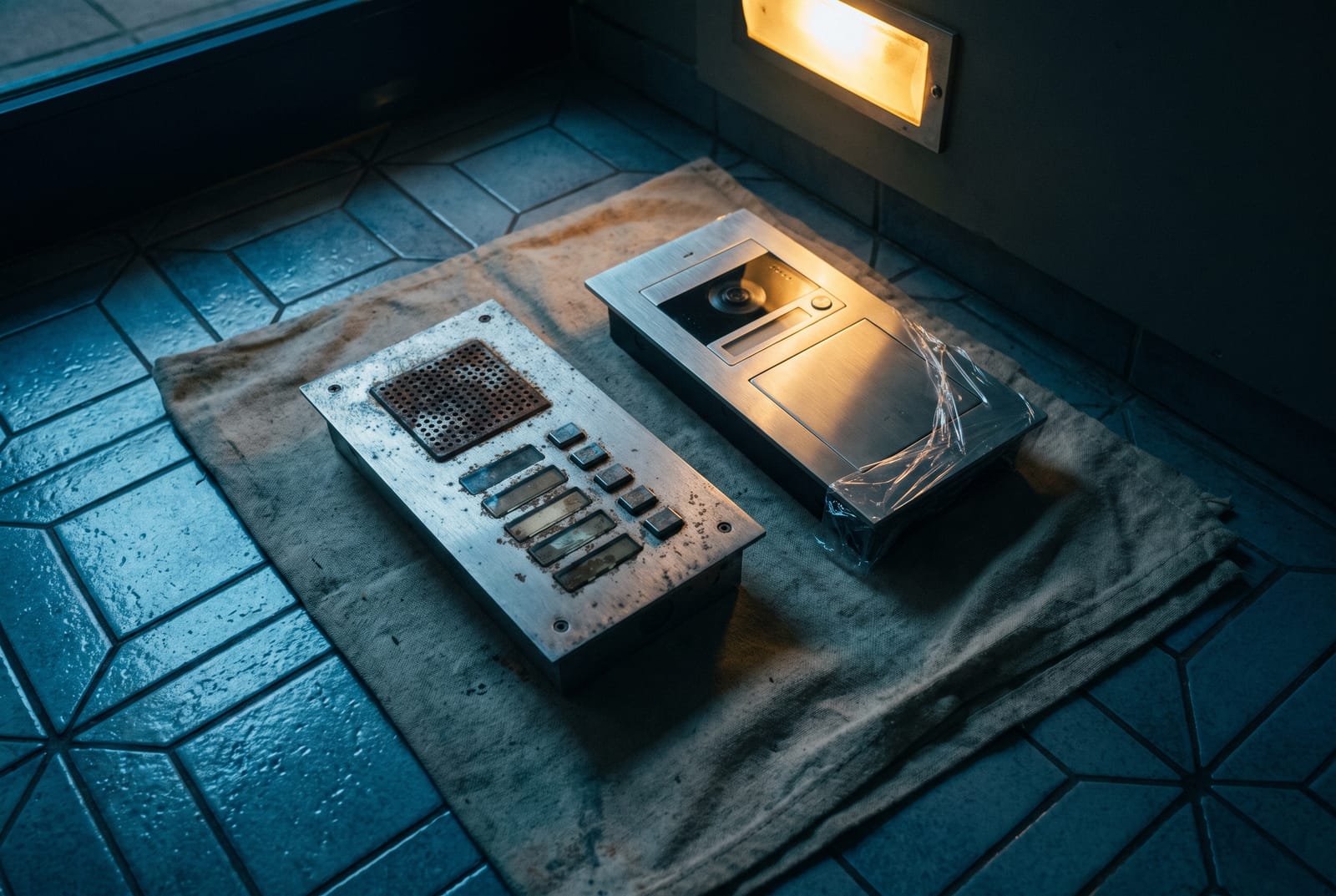
Legacy analog multi-tenant. The pre-war and post-war New York workhorse: a lobby panel with a speaker and one call button per apartment, feeding a central amplifier in the basement that drives an apartment riser. The classic riser is four-wire: three shared 22 AWG conductors for talk, common and buzzer, plus one dedicated selective conductor for each apartment. That is why a 60-unit building has a 60-plus-conductor riser cable and why adding a single unit means pulling new wire. The amplifier typically runs on a 16 VAC transformer, and its door release output is selectable for AC, DC or a magnetic lock.
Two-wire digital bus. A polarity-insensitive bus that multiplexes audio, video, power and control down a single pair, with distributors branching the riser. This is the single most important family in New York retrofits, because it rides the pairs that are already in the wall. Typical bus systems reach around 200 m between the entrance panel and an in-unit station, with larger variants scaling much further.
IP over Cat5e/Cat6. Every door station and every apartment station is a network endpoint, powered over Ethernet, usually speaking SIP or a vendor protocol. Excellent in new construction and gut renovation, and the wrong first answer in a pre-war building, because it assumes structured cabling to every apartment that does not exist and cannot be fished cheaply.
Cloud and mobile-first. One lobby panel plus a resident app: no in-unit hardware and no apartment riser at all. In a building where the riser is genuinely dead, that is the entire commercial argument, and it is a strong one. It also means every resident needs a smartphone and the building takes on a monthly bill forever.
Telephone entry. The panel places an actual phone call to the resident, who presses a digit to fire the door relay. Historically dependent on a copper phone line, which is why this family is now the largest single source of replacement work in the region.
Nobody sells the third column. It is the one that determines whether you are happy in three years.
| Architecture | Rides on | Good at | Bad at |
|---|---|---|---|
| Legacy analog audio | Existing 4-wire riser, 16 VAC amplifier | Cheap to keep alive, no network, no subscription, no app, works in a blackout with a battery | Audio only. Parts for discontinued amplifiers are a scavenging exercise. One shorted apartment station takes the whole building’s audio down |
| 2-wire digital bus | The existing pair, usually reusable | Video and modern features without opening walls; by far the least disruptive real upgrade in a pre-war building | Bus length and station counts are hard limits. Insulation type matters: these systems specify polyethylene-insulated cable, and PVC-jacketed wire off the truck has higher capacitance and degrades the bus |
| IP over Cat5e/Cat6 | A home run to every station, 100 m maximum | Cleanest integration with cameras and access control; standards-based; scales to thousands of stations | The 100 m channel limit is absolute. Large touchscreen door stations with heaters and IR exceed what a basic PoE port guarantees. In a plaster-on-lath building the cable pull, not the hardware, is the project |
| Cloud / mobile-first | One panel, internet, resident smartphones | No riser at all. Tenant turnover is a directory edit in a browser instead of a truck roll and a re-lettered panel | A permanent monthly cost, a hard dependency on your internet circuit, and a resident population that must all own and manage a smartphone. Ask in writing what happens to entry during an outage |
| Telephone entry | A phone line, or a cellular path replacing it | No in-building riser, no apps, residents use the phone they already have | Copper retirement is killing these. When the line is moved to a carrier VoIP path, the tone the resident presses gets compressed away and the door stops opening |
Typical hardware costs across these families vary by roughly an order of magnitude for the same number of units, which is exactly why we survey before quoting rather than after.
Nearly every intercom quote you will receive is really a bet about the riser. Ring it out and count usable pairs and the price changes by an order of magnitude, because a retrofit that reuses existing conductors and a full riser replacement are not the same job in the same universe.
What we check, in this order: how many conductors exist and how many still pass a continuity and insulation test; whether the insulation is cloth or rubber and whether it cracks when disturbed, a real risk in anything pre-1940; whether there is any usable pathway at all between floors, or whether the original installer simply chased the plaster; whether there is legacy RG-59 video coax in the building, which can often be reused with Ethernet-over-coax converters instead of abandoned; and whether the door hardware and closer are in a condition where any release mechanism will actually work.
Distances matter more than people expect. Bus-type analog systems commonly run to about 980 ft on 18 AWG from the entrance panel to the furthest station, with a cumulative system limit in the thousands of feet. Ethernet is a hard 100 m end to end. Neither of these is negotiable, and both are routinely discovered after the equipment has been bought.
The other thing we look for is what opening a wall would trigger. In a pre-1960 building, disturbing painted plaster brings lead paint procedures into scope, and that changes the schedule and the cost before a single cable moves.
Pick the one that matches what you need. Each goes into detail the category page cannot.
New audio or video entry systems, wired or IP, sized to the building and the riser rather than to a catalog.
Dead handsets, silent panels, buzzers that ring but never release, and the diagnostic sequence behind each symptom.
Obsolete systems and discontinued parts, including retrofits that reuse the existing riser instead of replacing it.
Lobby cameras, in-unit monitors and phone apps, plus what each choice costs you in ongoing dependency.
Multi-tenant systems from 6 to 200+ units, and what Multiple Dwelling Law §50-a actually requires of them.
Buzz-in entry for walk-ups, storefronts, offices and back-of-house doors, where the whole system is one button and one strike.
New York Multiple Dwelling Law §50-a requires an intercommunication system where three conditions are all true: the building is a Class A multiple dwelling, it was erected or converted for residential use after 1 January 1968, and it contains eight or more apartments. The system has to provide two-way voice communication between the apartment and a visitor at the main entrance, and it has to let the resident release the locking mechanism of that door from inside the apartment. The statute also ties the system to an automatic self-locking door giving access to the entrance hall. The door and the intercom are a single package, and a working intercom on a door that does not self-lock does not deliver what the law is after. Where a building is not already equipped, §50-a contemplates retrofit on the written consent of a majority of tenants.
Separately, NYC Administrative Code §27-2041.1, added by Local Law 111 of 2019, and §28-315.10 deal with self-closing doors in residential buildings with three or more units. That obligation is about the door closing and latching on its own, and it interacts directly with entry work: a strike or release that does not allow the door to fully re-latch has created a different problem than the one it solved.
Beyond the statute, a broken entry system in a multiple dwelling is treated as a hazardous maintenance condition, enforceable through a tenant complaint and inspection with a short correction window, and New York courts have treated a working intercom as an essential service tied to the warranty of habitability. The practical version for an owner or board: the repair is always cheaper than the violation plus the re-inspection cycle, and considerably cheaper than an abatement argument.
We are not attorneys and this is not legal advice. What we can do is document exactly what the building has, what it is missing, and what a compliant arrangement would look like, in a form your counsel or managing agent can act on.
Each of these is a call we have taken, a diagnosis we have made, or a decision we have argued a client out of.
Frequently not, and any contractor who tells you otherwise before ringing out the riser is quoting for their own convenience. A great many New York buildings can take a modern audio, and often video, entry system over the conductors that are already in the wall.
The path that makes this possible is the two-wire digital bus family, which multiplexes audio, video, power and control over a single pair. Where there are enough usable conductors, the work is concentrated at the lobby panel, the distribution point and the apartment stations, not in the walls of every public hallway. That is a different job, a different schedule and a different price.
Repair first, as a rule. A large share of “the intercom is dead” calls are a failed transformer, a corroded terminal block, water in a lobby panel, or a single shorted pair. All of those are repairable for a fraction of a replacement, and all of them are repairs we would rather do than sell you a system.
Replacement becomes the honest recommendation at three thresholds: when the manufacturer is gone and no parts exist in any channel, when the riser insulation has degraded to the point that new faults appear faster than we clear them, and when the annual service spend has passed what a new system would amortize to. We will show you which of those you are at rather than asserting it.
It depends on the riser and on the residents, in that order. If the riser is genuinely dead and a rewire is not fundable, a cloud panel with no in-unit hardware is a legitimate and often excellent answer. It removes the most expensive part of the job entirely.
Before signing, get written answers to four questions: what happens to entry during an internet outage, during a power outage, what the documented offline behavior is, and what the subscription costs at year five including any announced escalation. Also consider the residents who do not want an app on their phone. Many buildings land on a hybrid: app access for those who want it, physical stations or fobs for those who do not.
Often yes, along one of two paths. A two-wire video bus system will carry video over the existing pair to in-unit monitors, subject to distance and station limits that we check against the actual riser length before specifying anything.
The other path is a video panel at the door with the video going to residents’ phones rather than to in-unit hardware, which removes the riser question entirely for the video part while leaving the existing audio system in place if it still works. Which one is right is a survey question, not a preference.
It should not be, and that is a planning requirement rather than a hope. Work is phased so that door release capability exists at the end of every working day, using a temporary release arrangement during the cutover if the old panel has to come off before the new one goes on.
This is not just courtesy. In a multiple dwelling, an entry system that is out of service for an extended period is exactly the condition that generates a violation, so a phased cutover protects the owner as much as the residents.
Plan on four to eight weeks before work starts, and treat that as the normal case rather than a delay. Anything touching the lobby, vestibule or building-wide wiring runs under an alteration agreement, and the package typically wants detailed scope documentation, insurance requirements naming the corporation and managing agent, and sometimes an engineer’s or building architect’s review even where no permit is required.
What we can do is make that package easy to approve: a scope document written so a board can read it, photographs of what is actually in the riser, a clear statement of what is being reused versus replaced, and named unknowns with a capped allowance rather than open-ended language that a board will, correctly, refuse to sign.
NYC Administrative Code §28-105.4.7 exempts low-voltage work below 50 volts for signaling, communication, alarm and data from the permit requirement, with four carve-outs: life safety systems, hazardous locations, intrinsically safe systems, and any circuit that interfaces with a control circuit switching light, heat or power. That exemption was amended by Local Law 128 of 2024, effective 21 December 2025.
The practical reading is that a straightforward intercom or camera pull is generally outside the permit regime, and the moment the work interfaces with life safety or with a line-voltage control circuit, it is not. Determining which side of that line a specific scope falls on is part of the survey, not an afterthought.
Diagnosis and repair of dead handsets, silent panels, buzzers that ring but won't release.
Multi-tenant systems for 6 to 200+ units, and what MDL §50-a requires of them.
See who's at the door: lobby panels with cameras, in-unit monitors and phone apps.
Fobs, cards, keypads and phone-based credentials, plus the locking hardware and egress compliance behind them.
Walk-ups and elevator buildings, 6 units to 200+, and the law that governs their entry systems.
Board-vote timelines, shareholder communication, and phased work that doesn't blow the reserve fund.
Two photographs and a unit count get you a real technical answer about what your building can take. Everything after that comes from the survey.
Sun to Thu 9am to 5pm · Fri 9am to 12pm · Sat closed