Brooklyn is a retrofit borough, and the stoop is the whole problem
A third of Brooklyn’s housing units, about 362,500, require climbing at least one flight of stairs, the highest walk-up share in New York City. Almost none of them have a riser closet.
The largest housing stock in the city, and the lowest ceiling
1,077,654 housing units, 30% of everything in New York City, and only 34% of them are in a building with an elevator.
What Brooklyn has instead of elevators is three- and four-story brownstone and row-house across Brooklyn Heights, Cobble Hill, Carroll Gardens, Boerum Hill, Fort Greene, Clinton Hill, Park Slope, Prospect Heights, Bedford-Stuyvesant and Crown Heights; two-to-four-family frame, limestone and brick rows through Bushwick, Flatbush, Sunset Park, Bay Ridge and Canarsie; six-story pre-war walk-up apartment houses in Borough Park, Bensonhurst, Midwood and Sheepshead Bay; free-standing Victorians in Ditmas Park, Prospect Park South and Fiske Terrace; and a narrow band of new waterfront towers where Williamsburg gained 41% population between 2010 and 2020 and the Downtown Brooklyn-DUMBO-Boerum Hill area gained 67%.
That mix produces a specific kind of work. Nobody in a four-unit row house is buying a lobby turnstile. What they are buying is a system that has to live inside a building with no conduit, plaster over lath, a two-conductor riser installed sometime between 1965 and 1985, and a front elevation that in a great many neighborhoods cannot be altered without a permit from the Landmarks Preservation Commission.
Brooklyn is also where the condition of the stock shows up in the data: 71.7 serious housing code violations per 1,000 privately owned rental units, nearly double Manhattan’s 38.0. A dead buzzer and an entrance door that no longer latches are two of the most common items on that list, and both are ours to fix.
Two doors, and you can only sensibly lock one
Nearly every Brooklyn row house and small apartment house has the same entry: an outer door at the top of the stoop, a small vestibule with the mailboxes and the intercom panel, and an inner door into the stair hall. Which of those two doors carries the electric lock is the single decision that shapes the whole job, and it is a genuine trade-off rather than a right answer.
Lock the inner door and the install is straightforward: the frame is usually deep enough for a strike, the panel is out of the weather, and there is no LPC review because nothing changes on the street. What you give up is the vestibule. It becomes a heated, dry, unobserved room that anyone can enter, and that is where packages disappear from, where the panel gets pried, and where people sleep in January.
Lock the outer door and you protect the vestibule, but the outer door is often the original, with a shallow stile, a surface rim latch rather than a mortise lock, forty coats of paint, and in a historic district it is a protected element. That usually means a surface-mounted rim strike matched to the existing night latch, or an electrified rim exit device, plus an LPC permit if anything about it reads from the sidewalk.
Whichever door you pick, the closer decides whether it works. New York City requires self-closing entrance doors in residential buildings with three or more units, and the most common “the buzzer is broken” call we get is not a buzzer at all: the door has swelled, or the closer has lost its spring, and the door rests against the strike without ever latching. The lock was fine. The door was never closed.
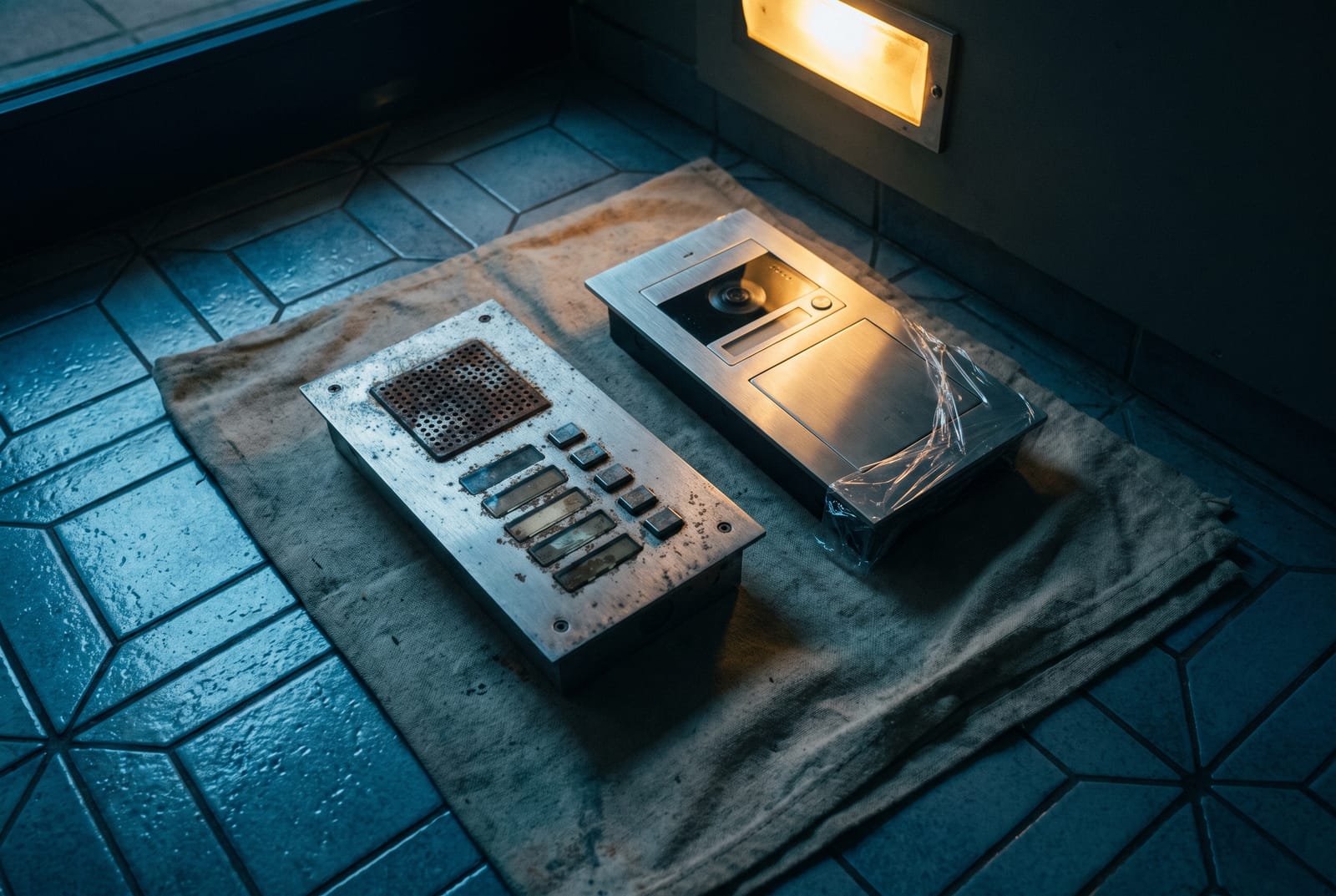
Six things that decide the price of a Brooklyn intercom
All of them are established at the survey. None of them can be established over the phone.
- How many usable conductors are in the existing riser. Most of these buildings have a 2-wire audio riser and nothing else. A great many can carry a modern IP video entry system over that same pair using 2-wire-compatible equipment, which is the difference between a two-day job and opening public-hall walls. We ring the pairs out before we quote, because that one measurement moves the price by an order of magnitude.
- What the cable actually is. Analog bus systems will run around 980 feet from the entrance station on 18 AWG, which is far more than any row house needs, but the manufacturers specify polyethylene insulation, and ordinary PVC-jacketed cable has higher capacitance that degrades the bus. If you are pulling new, this is the specification that separates a system that works on every floor from one that works on the second and fails on the fifth.
- Whether anything new appears on the facade. Brooklyn holds the densest concentration of row-house historic districts in the city: Brooklyn Heights was New York’s first, designated in 1965, followed by Park Slope, Fort Greene, Clinton Hill, Cobble Hill, Carroll Gardens, Boerum Hill, Stuyvesant Heights, Crown Heights North, DUMBO, Prospect Lefferts Gardens and Ditmas Park. A street-visible faceplate, camera housing, conduit run or door hardware change needs an LPC permit before any DOB filing.
- Where the panel can legally sit. Operable parts should be reachable without tight grasping, pinching or twisting, and no higher than 48 inches for a side reach. On a stoop where the only flat wall is the reveal beside the door, that constraint and the mailbox bank frequently compete for the same eighteen inches.
- The garden-level door. Almost every Brooklyn row house has a second entrance under the stoop, and it is nearly always an afterthought: a separate lock, a separate key, no station, no camera. If a unit is rented off that door it needs its own call button and its own credential group, or you have built a system that covers the front of the house and ignores the way people actually come in.
- Whether the building can go without release for a night. It cannot. We phase the cutover so every unit keeps a working door release from the end of each work day, because a building where a tenant cannot buzz anybody in is not just annoying. It is the exact condition that turns into a housing violation while you wait for parts.
When the landlord lives on the parlor floor
A large share of Brooklyn is owner-occupied two-, three- and four-family houses: the owner on one floor, tenants on the others, one front door and one shared vestibule between them. The technical problem is small and the human problem is not.
The system almost everyone has is a keypad with a single shared code, which means the code is on a sticker inside the vestibule, the last three tenants still know it, and the only way to change it is to change it for everybody including the owner. When a tenant leaves, nothing gets revoked. It just accumulates.
The fix is to stop treating the building as one credential. Each unit gets its own group: its own fobs or phone credentials, its own call button, and where there is a separate garden-level or basement entrance, its own door. Revoking a departed tenant then takes about fifteen seconds in a browser and affects nobody else in the house. It also means an owner can hand a cleaner or a contractor a credential that works on Tuesdays between nine and five and expires on its own, which is the sort of thing a mechanical key cannot do at any price.
Brooklyn is also the borough with the largest institutional stock in the city: 252 NYCHA developments totaling 60,273 units, more than any other borough, plus 91 Mitchell-Lama properties and 29,323 units. That work runs on procurement rules, standardized hardware across many buildings and per-building reporting rather than on a single owner’s decision, and it is scoped completely differently.
Where Brooklyn cameras go wrong
The most requested camera in this borough watches a stoop for package theft, and the most common way it is installed makes it useless. Mounted above the door at eight or nine feet and aimed down, it produces an excellent record of the top of a hood. Identification needs the lens closer to face height and aimed across the approach path rather than down at it: a station or doorbell camera at around four feet on the door reveal, or a second camera on the railing looking back up the stoop. One camera at the right height beats three at the wrong one.
Storefronts have their own version of this. A camera mounted inside the glass with its infrared illuminator on will bounce that light straight back off the window and white out the entire night image; either the illuminator gets disabled and the camera lives on street light, or the camera moves outside the glass line. And when the roll-down gate comes down, an interior camera is filming a steel gate, which is why gate position and rear-door propping are worth more than another lens at the front.
There is a lot of that work here. Brooklyn has 23 business improvement districts, among them DUMBO at roughly 1,350 businesses, Sunset Park’s Fifth Avenue at 640, Park Slope’s Fifth Avenue at 521, Bay Ridge’s Fifth Avenue at 376, Atlantic Avenue at 338, Flatbush Avenue at 308, Myrtle Avenue at 179, Church Avenue at 169, Brighton Beach Avenue at 140 and Montague Street at 100, plus the Brooklyn Navy Yard and Industry City, which are tenant-credentialing problems rather than storefront ones.
Brooklyn neighborhoods we work in
Thirty-seven ZIP codes, 11201 through 11239, from Greenpoint to Coney Island.
Brownstone Brooklyn and the waterfront
14 areas areas- Brooklyn Heights
- Downtown Brooklyn
- DUMBO
- Vinegar Hill
- Fort Greene
- Clinton Hill
- Boerum Hill
- Cobble Hill
- Carroll Gardens
- Gowanus
- Red Hook
- Park Slope
- Prospect Heights
- Windsor Terrace
North Brooklyn
5 areas areas- Williamsburg
- South Williamsburg
- East Williamsburg
- Greenpoint
- Bushwick
Central and East Brooklyn
15 areas areas- Bedford-Stuyvesant
- Stuyvesant Heights
- Crown Heights
- Prospect Lefferts Gardens
- Ocean Hill
- Brownsville
- East New York
- Cypress Hills
- Canarsie
- East Flatbush
- Flatbush
- Ditmas Park
- Prospect Park South
- Kensington
- Midwood
South and Southwest Brooklyn
17 areas areas- Sunset Park
- Borough Park
- Bay Ridge
- Dyker Heights
- Bensonhurst
- Bath Beach
- Gravesend
- Homecrest
- Sheepshead Bay
- Manhattan Beach
- Brighton Beach
- Coney Island
- Marine Park
- Mill Basin
- Bergen Beach
- Gerritsen Beach
- Flatlands
Common questions
We have a four-unit brownstone with the original 1970s buzzer. Can we get video without opening the walls?
Usually, yes. The two conductors running from the vestibule to each floor are the asset. 2-wire-compatible IP video intercoms are built precisely for this building type: video at the door, a monitor or a phone app in each unit, and door release, all over the pair that is already in the wall.
What has to be checked first is the condition of that pair, not just its presence. Cloth- and rubber-insulated conductors from the era crack when disturbed, and a splice buried behind eighty years of paint in the stair hall can read fine on a meter and fail under load. We ring it out end to end and tell you honestly whether it will carry the new system or whether you are looking at a partial pull, and if it is the latter, where that cable can actually go in a house with no conduit.
Should the lock go on the stoop door or the vestibule door?
If you want the vestibule protected (packages, the panel, the mailboxes), it has to be the outer stoop door, and that is the harder install: shallow stiles, a surface rim latch instead of a mortise lock, and in a historic district a permit if anything reads from the street. It is worth it in buildings that are losing deliveries.
If the vestibule is not the problem, lock the inner door and spend the difference on a better entry panel and a camera. What we will not do is fit a strike to a door that has no working closer, because an unlatched door is an unlocked door no matter what the electronics cost. If the closer is done, replacing it is part of the scope, not an upsell after the fact.
We’re in a historic district. Does that stop us changing the intercom?
No, but it changes the sequence. Anything visible from the street (the faceplate, a camera housing, surface conduit, a pedestal, changes to entry door hardware) needs a Landmarks Preservation Commission permit before a Buildings Department filing, and on a corner building the side elevation counts as street-visible.
In practice the approvable version of a Brooklyn intercom retrofit keeps the existing wall opening, replaces what sits inside it with a panel in a compatible finish and profile, and routes every new cable internally so nothing new appears on the brownstone or the brick. Scoped that way it is normally a Certificate of No Effect or a Permit for Minor Work rather than the much slower Certificate of Appropriateness route. We tell you which one your job is likely to need before you commit to hardware.
I rent out the garden apartment. How do I cut off a tenant’s access when they move out?
By making sure they never shared a credential with you in the first place. Each unit gets its own credential group, so revoking a departed tenant’s fobs or phone credentials takes seconds in a browser and does not touch your own or anyone else’s.
Two Brooklyn-specific details. First, the garden-level door under the stoop is usually on its own lock and gets forgotten. If the unit is entered that way it needs to be in the system, not just in the lease. Second, we register the platform to you, with your email as the account owner. A building that has to call a contractor to remove a former tenant’s fob does not actually control its own front door.
Packages keep going from our stoop. What actually helps?
In order of effect: a locked outer door so the vestibule stops being a public room; a call station or doorbell camera at about face height on the door reveal, because a camera above the door records the top of a head; and a second view from the railing or the parlor window that catches the approach up the stoop and the sidewalk beyond it.
Be realistic about what footage does. A clear frontal face at the door is what makes a report actionable. A wide shot of the whole block at night, from nine feet up, with a streetlight behind the subject, is what most people install and it identifies nobody. If the building has the space, a parcel locker or a lockable vestibule cabinet solves the problem outright and the cameras become a record rather than a hope.
Work that usually comes with this
Intercom Replacement & Upgrade
Replacing obsolete systems, including retrofits that reuse existing riser cable.
Video Intercom Systems
See who's at the door: lobby panels with cameras, in-unit monitors and phone apps.
Door Buzzer Systems
Buzz-in entry for walk-ups, storefronts, offices and back-of-house doors.
Security Camera Installation
New IP camera systems for buildings, storefronts, offices and homes.
Apartment Buildings
Walk-ups and elevator buildings, 6 units to 200+, and the law that governs their entry systems.
Small Business & Retail
Storefronts, bodegas, salons and offices: cameras, buzz-in entry and back-of-house control.
Send the address and how many units.
For a Brooklyn row house that is nearly enough to tell us what is in the wall. We’ll come and confirm it, ring out the riser, and put the options in writing, including the ones that cost you less.
Sun to Thu 9am to 5pm · Fri 9am to 12pm · Sat closed