The layer you cannot change later without opening the ceiling again
Cameras, readers, intercoms, phones and access points all sit on top of the same thing: copper and fiber somebody pulled through a building. Get the category, the jacket rating and the certification right once, and nothing above it argues with you for twenty years.
Everything else is a swap. Cable is a construction project.
A camera is a bracket and forty minutes. A card reader is a faceplate. A switch is a rack screw. Every one of those can be changed out in an afternoon in ten years’ time when something better exists.
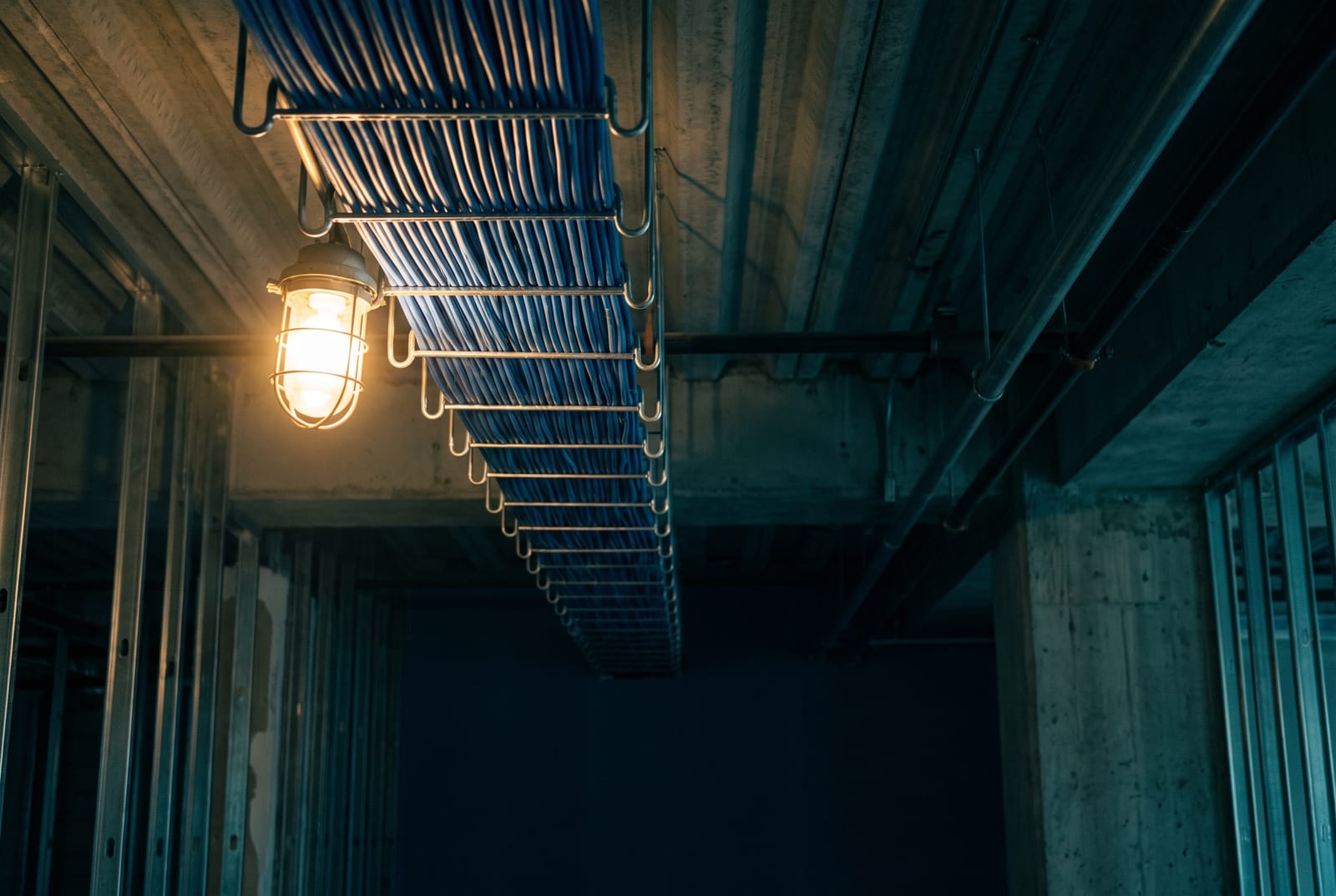
Cable is different, because the cost of cable is almost entirely the cost of getting to where it has to go: opening a ceiling, coring a slab, fishing a partition, firestopping the penetration, closing it back up and repainting. In a finished, occupied New York building that pathway work routinely costs two to three times what the same drop costs in new construction before the drywall goes on. Which means the only sane strategy is to decide the pathway once and put more capacity in it than today’s job needs.
That is the whole argument for specifying by pathway rather than by device. If we are already opening the ceiling of a corridor for four cameras, the marginal cost of pulling two spare runs and a conduit sleeve to the far end is small. It is the difference between the next access point, the next reader or the next camera being a morning’s work or a change order with a plasterer in it.
Everything below is what we actually do on site and what we hand over at the end. If a cabling quote you are holding does not mention jacket rating, a certification standard, or how the cable will be supported, those three omissions are where the money quietly went.
What each category is actually good for
| Media | Real limits | When we specify it | Typical installed cost per drop |
|---|---|---|---|
| Cat5e | 1 Gbps to the full 100 m channel. Adequate for 2 to 4 MP cameras and most readers. | Rarely on new work. The cable is cheaper; the labor is identical, and labor is the job. Where it already exists and tests clean, we reuse it rather than replacing it for the sake of it. | $125 to $300 |
| Cat6 | 1 Gbps to 100 m, but 10GBASE-T only to about 55 m, and less than that in tight bundles or long parallel runs, where alien crosstalk between adjacent cables eats the margin. | The workhorse for camera, reader and general data drops where nothing is going to need 10 Gb at that outlet. Most of what we pull. | $125 to $400, typically $150 to $250 in grouped commercial work |
| Cat6A | 10GBASE-T at the full 100 m channel: 90 m of horizontal run plus 10 m of patch cords. The only copper category that requires alien crosstalk testing as part of certification. | Wireless access point drops, uplinks, anything feeding a multi-gig port, and dense bundles carrying 60 to 90 W of PoE, because the larger conductors shed heat better. | $175 to $500 |
| Multimode fiber (OM3/OM4) | Building backbone distances well past the 100 m copper limit, at 10 Gb and above. | Riser backbone between floors and between IDFs. Also the answer any time a camera or reader sits beyond 90 m of horizontal copper. | $300 to $700 |
| Singlemode fiber (OS2) | Campus distance, effectively unlimited for our purposes, and bandwidth headroom you will not outgrow. | Between buildings, out to gate houses and parking structures, and anywhere the future bandwidth is genuinely unknown. Fiber also gives galvanic isolation, which removes ground-potential and surge problems between separate structures, a real fault, not a theoretical one. | $350 to $900 |
All figures typical and subject to survey. Per-drop cost falls sharply with volume, because mobilization and minimum-day labor spread across more outlets: a ten-drop job can genuinely run $400 a drop while a five-hundred-drop job in the same building runs $175. New construction before drywall runs $100 to $150 a drop; the same drop in finished occupied space runs $300 to $400.
Plenum, riser or general purpose: when the code takes the choice away
Communications cable is listed by where it is allowed to go, and the letters on the jacket are not a quality grade. CMP is plenum, CMR is riser, CM and CMG are general purpose, CMX is limited use. Substitution runs one way only: CMP can go anywhere, CMR can go in a riser or a general space, and CMR can never go in a plenum.
Plenum-rated cable is required in spaces used for environmental air movement, the classic case being above a drop ceiling or under a raised floor where HVAC return air travels through the open space without ductwork. The listing exists because of what burning cable does in that space: CMP jackets have to pass the Steiner tunnel test under NFPA 262 for flame spread and smoke density, because in a plenum the smoke goes wherever the air handler sends it. Riser cable passes a different test, the vertical tray flame test under UL 1666, aimed at stopping fire climbing a shaft between floors.
The distinction that gets jobs pulled back out: a ducted return is not a plenum, but a shared open ceiling used as a return is. You cannot tell by looking up, and neither can the person quoting the job over the phone. We get the mechanical drawings or ask the building’s MEP before pricing the cable, because the difference between CMP and CMR on a two-hundred-drop job is real money and getting it wrong means removing all of it.
The same families exist under other articles for other systems: CL2P/CL3P and CL2R/CL3R for Class 2 and Class 3 power-limited control and signaling circuits, which is where access control, intercom and door hardware wiring lives under NEC Article 725; and separate listings under Article 770 for optical fiber and Article 800/805 for communications circuits. Access control cable in a plenum needs a plenum listing exactly as much as a data cable does, and this is one of the more common things we find wrong in buildings where different trades pulled at different times.
One New York wrinkle worth knowing: the city enforces its own amended electrical code on a different adoption cycle from the state Uniform Code that governs Nassau, Suffolk and Westchester. Which edition applies to your address can change the exact wording of a requirement, so we confirm the adopted edition for the jurisdiction rather than reciting an article number from memory.
What separates a cable that certifies from one that merely works
Almost all of this is invisible once the ceiling is closed, which is precisely why it gets skipped.
- Support from the building structure, not from whatever is handy. Cable goes on J-hooks or bridle rings anchored to structure at proper intervals. It does not get laid on ceiling tiles, hung off sprinkler pipe, tie-wrapped to conduit or draped over a light fixture. Every one of those is a code problem and several are a life-safety problem, because the sprinkler line is now carrying a load nobody designed it for.
- Bend radius and pull tension respected. Four-pair copper wants a bend radius of at least four times the cable diameter and a maximum pull tension around 25 lbf. Exceed either and you deform the twist geometry permanently. The cable will still link at 1 Gb and then fail return loss on the certification test, or worse, pass today and produce intermittent errors under PoE load in eighteen months.
- Cable ties that do not crush. Overcinched nylon ties deform the jacket and the pairs underneath, which is a genuine cause of failed NEXT and return loss results. Hook-and-loop wrap, dressed but not strangled, on every bundle.
- Every rated penetration firestopped to the assembly’s listing. Not foam from a can, not a rag. The correct listed system for that wall or floor assembly and that penetrant, installed as tested. This is inspected, and it is the item most likely to fail an inspection on an otherwise clean job.
- Labeling at both ends, to a scheme that survives us. Machine-printed labels following an administration standard, a numbering scheme that matches the patch panel and the outlet, and a printed record handed over. The next person to open that ceiling should not need a toner and an afternoon to find out where a cable goes.
- Certification with a field tester, and the results handed to you. Every run tested for the permanent link, and the channel where patch cords are part of the delivered system. Cat6A additionally requires alien crosstalk testing. Certification adds roughly 5 percent to installation cost and it is what unlocks a manufacturer’s 20 to 25 year materials-and-labor warranty. No major manufacturer warrants uncertified plant. You get the test report file, not a verbal assurance.
- Abandoned cable comes out. Dead cable left in a ceiling is fuel and it is a code violation. On retrofit work we identify what is genuinely abandoned, get agreement on removing it, and take it with us. On a forty-year-old riser this is sometimes the largest single item in the scope, and it is always the one nobody else quoted.
Two physical limits that decide the design
One hundred meters, and what it actually means
The Ethernet channel limit is 100 m end to end: 90 m of horizontal cable in the wall plus a combined 10 m of patch cords at the outlet and the patch panel. It is not 100 m of horizontal run, and the difference matters, because the two most common causes of an intermittent camera are a run measured optimistically from a floor plan rather than walked, and a long patch cord added later by somebody solving a different problem.
Past that limit there are three honest options and we will tell you which one your building needs: a fiber leg to a small switch closer to the devices, a mid-span or extender where the run is only slightly over and the environment is benign, or moving the IDF. Long yard runs, gate houses and separate structures go on fiber for a second reason as well: fiber is a dielectric, so it does not carry a ground potential difference or a surge from one building to another, which is a real failure mode on a detached garage or a gate operator and one that destroys electronics on both ends.
PoE heat, and why Cat5e stops being the cheap option
Power over Ethernet has gone from 12.95 W at the device on 802.3af, to 25.5 W on 802.3at, to 51 W and 71.3 W on the two 802.3bt types, and the higher types push current down all four pairs. All of that current turns into heat inside the cable, and inside a tightly packed bundle the cables in the middle have nowhere to dump it. The standards handle this with bundle de-rating, and the practical consequence is that larger conductors run cooler: Cat6 and Cat6A dissipate heat better than Cat5e and de-rate less aggressively. On any bundle carrying high-power PoE devices we specify Cat6A and cap bundle sizes rather than pulling one enormous bundle because it is faster.
Two absolutes. Copper-clad aluminum is never used on our jobs: it cannot handle PoE current properly, it does not meet the specification, and it is not listed for the application. The fact that it is half the price of copper is the entire reason it exists. And the switch power budget is not the port count multiplied by the port rating; a 24-port switch with a 180 W budget will not run 24 cameras drawing 25 W each, and that arithmetic belongs on the design, not in a February phone call.
Permits: what NYC exempts, and the four exceptions that catch people
NYC Admin Code §28-105.4.7 provides a permit exemption for the installation of low-voltage systems operating below 50 volts for signaling, communication, alarm or data purposes. That is why the great majority of camera, intercom, access control and data cabling work in New York City does not need a DOB permit pulled for the cable itself.
The exemption has four exceptions, and they are where the trouble is. It does not apply to life safety systems, to work in hazardous locations, to intrinsically safe systems, or to any system that interfaces with a control circuit switching light, heat or power. That last one is the one people walk into: the moment your low-voltage system is switching something that switches line voltage, you are outside the exemption. The section was amended by Local Law 128 of 2024, effective 21 December 2025.
None of this displaces the other approvals. Fire-rated penetrations still have to be firestopped to the assembly listing and that gets inspected. Line-voltage work (a new circuit, a new receptacle for a rack, anything on the load side of a panel) is a licensed electrician’s work and we coordinate it rather than doing it. And any interface to a fire alarm control panel is fire alarm work performed by the building’s licensed fire alarm contractor; where a job needs one, we provide and terminate a relay in an adjacent enclosure and they make the connection at the panel.
What the building does to the estimate
Pre-war plaster is applied over wood or wire lath, and it does not fish. The lath catches the rod, and forcing it cracks a two-foot section of ceiling in the apartment below. Terra-cotta block partitions do not fish either and split on the far face when drilled without care. Post-war concrete means core drilling and coordination with the building about what is in the slab. Cast-iron and landmarked facades usually rule out exterior raceway entirely.
Then there is everything that is not construction: a certificate of insurance naming the building, the managing agent and the owner, often at $2M to $5M limits; an alteration agreement; freight-elevator booking windows; and work restricted to hours when noise will not reach an occupied apartment or a trading floor. On union or prevailing-wage projects the labor rate itself is a multiplier. None of it is technical and all of it is schedule, so it belongs in the scope document rather than in week two.
A telecom room built properly (rack, patch panels, grounding and bonding, cable management, power and enough clearance to work) typically runs $1,500 to $4,000, subject to survey. It is also the single item most often value-engineered out, and the reason so many buildings have a switch sitting on a shelf above a mop sink with cable hanging in loops off a nail.
What you get at the end: the labeled cable map, the certification test results as a file, a rack elevation and port-to-outlet record, and photographs of every pathway before it was closed. If you replace us, your next contractor starts with a map instead of a toner.
Common questions
Cat6 or Cat6A? Everyone tells me something different.
Decide it per outlet rather than per building, because the cable is a small share of the cost and the labor is identical either way. Cat6 handles 1 Gb to the full channel and 10 Gb to about 55 m, less in a tight bundle or a long parallel run, where crosstalk from neighboring cables eats the margin. For a camera drop, a card reader, a desk phone or a printer, that is plenty and will remain plenty.
Cat6A earns its price in three places: wireless access point drops, because access points are where multi-gig ports actually appear; switch uplinks and anything running between closets; and any bundle carrying high-power PoE, because the larger conductors dissipate heat better and de-rate less. Cat6A is also the only copper category whose certification requires alien crosstalk testing, which is exactly the failure mode that bites dense bundles. A sensible building is usually mostly Cat6 with Cat6A where those three cases live.
How far can a cable run before we have a problem?
One hundred meters for the whole channel: 90 m of horizontal cable in the building plus a combined 10 m of patch cords at both ends. Measured along the actual route the cable takes, not across the floor plan. A run that looks like 70 m on a drawing can be 110 m once it goes up a wall, across a ceiling, around a shaft and back down.
Beyond that, the options in order of how often we use them: a fiber leg to a small switch nearer the devices, which is the right answer surprisingly often and is not expensive; a mid-span extender where the overrun is small and the environment is benign; or relocating the IDF. For anything reaching a separate structure (a gate house, a detached garage, a parking deck, a second building) fiber is the answer regardless of distance, because a dielectric link carries no ground potential difference and no surge between the two structures. Copper between buildings is one of the more reliable ways to destroy equipment at both ends during a storm.
Do we need plenum cable? The last contractor said it did not matter.
It matters, and the test is not the price of the cable, it is what the ceiling space does. If the space above the drop ceiling is used to move return air back to the air handler without ductwork, that is a plenum and it requires plenum-listed cable. If the return is fully ducted, it is not a plenum and riser or general-purpose cable is permitted. You cannot determine this by looking up at the tile; it comes off the mechanical drawings or from the building’s MEP.
Getting it wrong in the cheap direction is expensive, because the remedy is not a fine, it is removing and replacing the cable. Getting it wrong in the safe direction costs money for no benefit. Note also that substitution only runs one way (plenum cable is acceptable in a riser or a general space, but riser cable is never acceptable in a plenum) and that the same rule applies to access control and intercom cable, which is a different listing family and gets forgotten constantly.
What does certification actually get me? Is it not just a test?
It is a test, and it is the difference between cable that is known to be good and cable that currently links. A field tester measures the parameters that predict future failure rather than present function: insertion loss, near-end and far-end crosstalk, return loss, delay skew, and on Cat6A the alien crosstalk between adjacent cables. Plenty of runs with a crushed tie, an over-tight bend or a marginal termination will link at 1 Gb today and fail certification, and those are exactly the runs that go intermittent under PoE load two years later.
Commercially, certification is also what unlocks a manufacturer’s 20 to 25 year materials-and-labor warranty; no major manufacturer warrants uncertified plant. It adds roughly 5 percent to installation cost. We hand over the test result file, so you own evidence of what was installed rather than an assurance that it was fine. If a cabling quote does not mention certification, that 5 percent is where a competitor found room to be cheaper.
There is already cable in the building. Can you use it?
Often, and it is the first thing we check, because in a finished building the pathway is the cost and existing pathway is money already spent. We test what is there rather than guessing: category and jacket rating off the print on the jacket, length, and a certification test on each run we intend to keep. Cat5e that tests clean is perfectly good for cameras and readers and we will happily reuse it.
What rules it out: copper-clad aluminum, which we occasionally find and always replace because it cannot carry PoE current safely; cable with the wrong jacket rating for the space it passes through; runs that are physically damaged, crushed or over-length; and anything terminated so badly that re-terminating is more work than pulling new. In a legacy riser we also look for whether new cable can even use the same route, because a 1926 shaft packed with sixty years of abandoned cable sometimes has to be cleared before anything new can go up it. That clearing work is a scope item that other quotes will not have included.
Why does the price per drop change so much between quotes?
Because a drop is not a unit of cable, it is a unit of access. The same Cat6 outlet costs $100 to $150 in new construction before the drywall goes on, and $300 to $400 in a finished occupied space where somebody has to open a ceiling, work around furniture and put it all back. Fiber runs $300 to $900 a drop for the same reason plus termination.
Volume moves it as much as difficulty. Mobilization, minimum-day labor, and the time spent getting a crew and materials into a Manhattan building spread across however many outlets you are installing, so a ten-drop job can genuinely be $400 a drop while a five-hundred-drop job in the same building is $175. When you compare two quotes, the questions that explain most of the gap are: what jacket rating did each of them price, is certification included, is firestopping included, is abandoned cable removal included, and does the number assume normal hours or a freight-elevator window at seven in the evening. All figures here are typical ranges and subject to survey.
Work that usually comes with this
WiFi & Access Point Installation
Commercial wireless and building-wide coverage that survives brick and lath walls.
Security Camera Installation
New IP camera systems for buildings, storefronts, offices and homes.
Access Control Installation
Complete door-control systems, from a single door to a multi-building portfolio.
Commercial Security Cameras
Retail, restaurant, warehouse and office systems, including NDAA-compliant hardware.
Low Voltage & Cabling
The Cat6, fibre, risers, racks and wireless that everything else depends on.
Send us the floor plan and the outlet count.
We’ll walk the pathway, tell you what the ceiling is really made of, and come back with a drop count, a jacket rating and a fixed price, certification included, not extra.
Sun to Thu 9am to 5pm · Fri 9am to 12pm · Sat closed