Access control, from the credential in a pocket to the strike in the frame.
Card, fob, code or phone on one side. Strike, maglock, request-to-exit and a fire alarm interface on the other. We design and install both halves, for buildings across the five boroughs, Long Island and Westchester.
A controlled door is nine parts. Most quotes price three.
Reader, strike, controller, done. That is how access control gets sold. It is also why the second year of ownership costs more than the install did.
Every door we put under control is a chain: a credential, a reader, the wiring back to a controller, the controller itself, a power supply, a standby battery, the locking hardware, a way for people to get out, and a switch that reports whether the door is actually shut. Nine links. A quote listing a reader, a strike and a panel has priced three of them and is quietly assuming the other six either already exist or do not matter.
They matter, and the ones that get left off are always the invisible ones: the door position switch, the request-to-exit device, the standby battery, and the fire alarm interface that decides which locks drop when the building goes into alarm. Leave them out and the system still looks fine on handover day. It fails later, and it fails in ways that read as random: doors dropping offline overnight, alarms nobody can explain, a service entrance that has been propped open since March and no record of it anywhere.
So before we quote a door, we walk it. Frame material and depth, existing lock type, latchbolt projection, closer tension, whether the door is fire-rated, where the nearest reachable power is, and what route cable can physically take. Then here is the list we price against.
Nine components, and the failure mode for each
| Part | What it does | What happens when it is missing or wrong |
|---|---|---|
| Credential | The fob, card, phone or code a person carries. | A 125 kHz proximity fob is copied in about fifteen seconds with a handheld device costing under $30. Your access list becomes a suggestion. |
| Reader | Reads the credential and passes it to the controller. | Mounted at the legacy 54-inch height it breaks the 48-inch maximum side reach in the 2010 ADA Standards §308.3. Mounted outdoors without a gasket it fills with water in one winter. |
| Reader-to-panel wiring | Carries the credential number back to the controller. | Wiegand sends that number in plaintext on two conductors. A device wired in behind the reader harvests every credential presented and can replay them, and Wiegand has no mechanism to notice. |
| Controller | Holds the access list, makes the decision, fires the relay, writes the log. | A standalone appliance at every door multiplies your license count, your firmware versions and your points of failure. One multi-door controller in a closet is usually cheaper and always easier to service. |
| Power supply | Fused, individually controlled 12 or 24 VDC outputs, with a battery charger. | Undersized supplies sag on inrush. Four strikes at a quarter-amp each is one amp of demand, so the supply gets specified at 1.25 A minimum, not 1 A. |
| Standby battery | Keeps doors working through a power cut. | Access supplies disconnect their DC outputs when battery voltage falls to roughly 70 to 75% of nominal, so a tired battery starts dropping doors offline well before it looks dead. |
| Locking hardware | Electric strike, magnetic lock, electrified lever or electrified exit device. | The wrong device on a fire-rated assembly voids the label. The wrong device on an egress door is a code violation with a person’s life on the other side of it. |
| Request-to-exit | Lets people leave and tells the panel the exit was legitimate. | Without it every normal exit registers as a door-forced alarm. Within a month nobody reads the alarms, which is the same as not having them. |
| Door position switch | Reports open or closed. | Without it you cannot generate a door-forced or door-held-open alarm, cannot confirm the strike re-latched, and cannot tell propped from closed. This is the single most common omission we find on systems other people installed. |
Not every door needs all nine. An interior office door on a fail-secure strike is a simpler animal than a lobby entrance. But the parts you leave off should be a decision written down, not an accident.
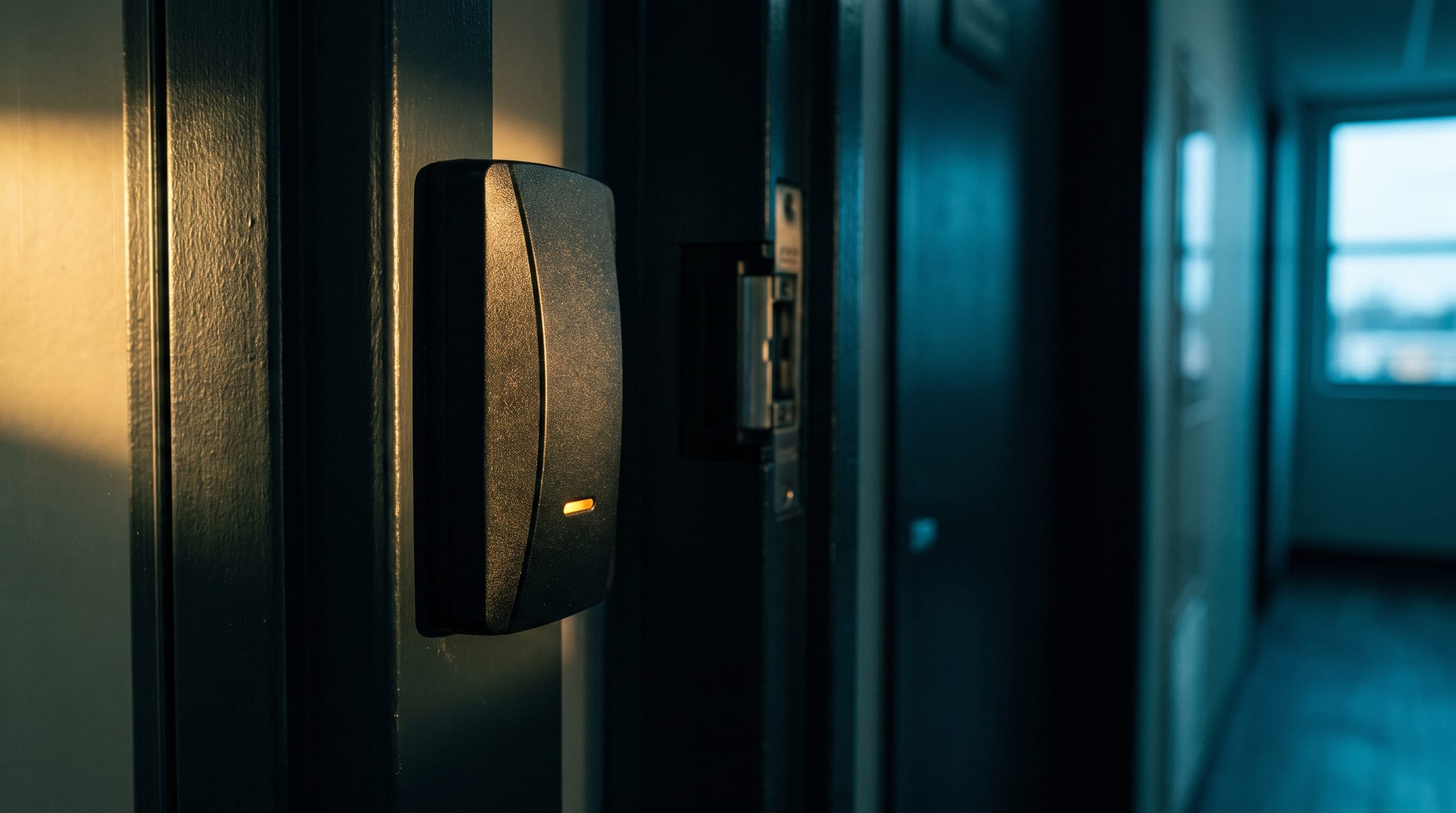
Strike, maglock, electrified lever or crash bar, and the one the code picks for you
Electric strike. Usually the right answer and usually the cheapest. The mechanical lock stays where it is; the strike releases the latch on command. Selection is driven by the lock it mates to and the frame it lives in. Cylindrical locks are straightforward. Mortise locks are harder, because the latchbolt centerline sits off from the standard prep and you need an extended faceplate to hide the shift. Rim exit devices need a strike matched to the bolt style. Aluminum storefront jambs are only about one and three-quarter to two inches deep, and a good number of standard strike bodies simply will not fit. Finding that out on install day is a change order, which is why the jamb gets measured during the survey. And a detail almost nobody checks: the deadlatch finger has to land on the strike face, not fall into the pocket, or the door can be shimmed open with a piece of plastic.
Magnetic lock. Six hundred or twelve hundred pounds of holding force, no moving parts, no latch. It holds only while it is powered, so it is always fail-safe, and it draws current the entire time the door is locked rather than for the two seconds of an unlock pulse. That one fact multiplies the standby battery a building needs, and it is why a maglock building and a strike building of the same size have completely different power rooms. A maglock also cannot be used on a fire-rated door assembly, because a fire door has to stay positively latched to hold smoke back.
Electrified lever and electrified exit device. Used where the lock itself has to be the controlled element: a stair door, an exit door with a push bar, a glass entry. Current has to cross the moving door through an electric hinge, an electric power transfer or a surface door loop, and the most common cause of a door that works intermittently for two years and then quits is a door-loop conductor work-hardening and fracturing after a few hundred thousand cycles. On vertical-rod exit devices there is a specific trap: electrify only the top latch and the door is held at a single point, and over a couple of seasons it warps.
Fail-safe versus fail-secure is not a preference. Fail-safe means power off equals unlocked. Fail-secure means power off equals locked. On a fire-rated door assembly the electrified hardware has to be fail-secure and listed for fire door use. On a magnetic lock, a delayed-egress arrangement, or a stair re-entry lock it has to be fail-safe. Either way, the egress side must open mechanically in one motion whether or not there is power. That part never changes, and any design that asks a person to know a code or find a credential in order to leave is wrong before you price it.
“Just put a maglock on it” is usually the wrong answer
A magnetic lock on a door people use to leave the building is a special locking arrangement. NYC Building Code §1010.1.9.8 (sensor release of electrically locked egress doors) sets out what has to come with it. All of it, not the convenient parts:
- A sensor on the egress side arranged to detect an approaching occupant and unlock the door.
- Loss of power to the sensor, or to the lock, automatically unlocks the door.
- A manual release mounted 40 to 48 inches above the floor and within 5 feet of the door, which directly interrupts power to the lock, independent of the controller, the reader and the software, and holds it unlocked for at least 30 seconds.
- That release signed
PUSH TO EXIT. - Fire alarm activation unlocks the doors, and they stay unlocked until the fire alarm system is manually reset. Sprinkler or automatic detection activation does the same.
- Emergency lighting on the egress side, and locking units listed to UL 294.
That is a package, and it carries a real price. It is also why the honest answer to “can you just put a maglock on the stair door” is usually no. An electric strike or an electrified lever on the entry side, leaving the mechanical egress hardware untouched, does the same security job without any of it. Where a maglock genuinely is the right device, the fire alarm interface has to be coordinated with the building’s fire alarm contractor, because fire alarm work is a separate licensed trade and we do not touch that panel. And NYC Fire Code §1027.3.1 requires egress hardware to be maintained in working order at all times, so this is a standing obligation, not a one-time inspection.
Six decisions we make before anything is ordered
These are the choices that determine what the system costs to own, not what it costs to buy.
- Fail-safe or fail-secure, door by door, in writing. Not a system-wide setting. On a building with a fire alarm interface, the disconnect is selectable per output for exactly this reason: the maglocks on the stair doors have to drop on alarm and the fail-secure strikes on the fire-rated doors must not. Getting that mapping backwards is simultaneously a code violation and a security hole, and it is invisible until somebody pulls a station.
- Credential technology. 125 kHz proximity transmits a fixed number in the clear with no encryption and no mutual authentication. Encrypted 13.56 MHz credentials with AES-128 and mutual authentication are a different class of object. We explain the difference on the key fob page, and we will not quote a new prox-only system without telling you what you are buying.
- OSDP or Wiegand between reader and panel. Wiegand is one-way, unencrypted and unsupervised: three signal conductors carrying a plaintext credential number, about 500 feet maximum, one home run per reader. OSDP is a two-conductor RS-485 pair that reaches roughly 4,000 feet, daisy-chains several readers on one cable, supervises them so the panel knows when a reader goes offline or is swapped, and with Secure Channel encrypts the link with AES-128. The step nearly everyone skips is moving the readers off the default install key onto a unique one. We do it, and we write down that we did.
- Open platform or proprietary. A large share of “different” systems run the same open controller boards underneath, which means the head-end software can be changed later without replacing panels. Closed platforms bind the hardware, the credentials and often the admin account to one dealer. That is not a technical limitation, it is a commercial one, and its purpose is to make your next contractor be us. We would rather earn the second job.
- Power and battery arithmetic. Total the inrush and holding current of every lock, every reader and the controller, add 25%, then size the battery for the standby time you actually want. Because a magnetic lock is energized the whole time it is locked and a fail-secure strike is only energized during the unlock pulse, a maglock building needs a dramatically bigger battery for the same number of doors.
- Mounting heights and hardware operability. Readers, keypads and exit buttons go where a person in a wheelchair can reach them, within the 48-inch side reach of the 2010 ADA Standards. Door hardware operable parts sit between 34 and 48 inches and must work with one hand, without tight grasping, pinching or twisting, which rules out knobs and thumb-turns on an accessible route. NYC Building Code Chapter 11 references ICC A117.1-2009, and where the two differ dimensionally you follow whichever gives the greater accessibility.
What a door typically costs
| Scope | Typical installed range per door | What moves it |
|---|---|---|
| Interior door, existing cylindrical lock, reader plus fail-secure strike on a shared controller | $1,200 to $2,200 | Cable route length, frame material, whether the strike drops into the existing prep or the frame needs cutting |
| Aluminum storefront entry | $1,800 to $3,200 | Jamb depth of roughly two inches, sidelites, and whether the existing narrow-stile lock has to be swapped before it can be electrified |
| Magnetic lock on an egress door with the full sensor-release package | $2,600 to $4,500 | Motion sensor, PUSH TO EXIT station, emergency lighting check, and coordination with the fire alarm contractor for the release interface |
| Electrified lever or exit device on a fire-rated door | $2,800 to $5,500 | The listed hardware itself, plus an electric hinge or power transfer to get current across the moving door |
| Adding a door to a controller that already has a spare port | $700 to $1,400 | Almost entirely cable route and labor |
Typical ranges in our service area, subject to survey. They cover hardware, cable, power, commissioning and documentation. They exclude any cloud or head-end subscription, and they exclude line-voltage work, which belongs to a licensed electrician. A price quoted before anyone has looked at the frame is a guess, and guesses become change orders.
Common questions
Can you add access control to the intercom we already have?
Usually, and it is often the cheapest useful upgrade in the building. Most entry intercoms release the door through a dry contact, so the access controller can share the same locking hardware. There are two ways to combine them and they are not equivalent. Wiring the access relay in parallel with the intercom release is quick but the access system never learns that the door was opened. Bringing the intercom release into the controller as an input costs a little more and gives you one event log that shows both the credential reads and the buzz-ins.
The trap on older buildings is AC versus DC. Many legacy intercom strikes are AC, which is what produces the loud buzz residents use as feedback. A DC strike fed AC will not release reliably; an AC strike fed DC overheats. And if we swap an AC strike for a quiet DC one, the buzz disappears and you get calls about it, so we tell you that before we do it, not after.
Do we need a DOB permit for access control work?
Often not for the low-voltage portion. NYC Admin Code §28-105.4.7 exempts wiring designed to operate below 50 volts for signaling, communication, alarm and data transmission from the electrical permit requirement. That covers the reader cable, the RS-485 or Wiegand run, the door contacts and the lock wiring itself.
There are four exceptions, and the fourth is the one that catches access control: a point of connection to or interfacing with a control circuit that activates light, heat or power. The 120-volt feed to the access power supply falls on the licensed electrician’s side of that line, as does any interface that switches a line-voltage circuit: a door operator, an elevator relay, a smoke-control interlock. Life safety systems are also excepted, which is another reason fire alarm interfacing is coordinated with the building’s fire alarm contractor rather than performed by us. Note also that Local Law 128 of 2024 amended this section effective 21 December 2025, so if you are working from an older memo, check it.
What happens to our doors in a power cut?
Exactly what you specified, which is why we specify it per door and put it in the scope document. Fail-secure strikes stay locked and the doors keep their mechanical egress function, so people can always get out. Magnetic locks release, because that is the only legal way a maglock can behave. Anything on the egress path releases.
What keeps the system running rather than merely safe is the standby battery, and this is where the maglock decision bites. A fail-secure strike draws current for perhaps two seconds per opening; a maglock draws continuously for as long as it is locked. Size a battery for a four-door maglock building the way you would for a four-door strike building and it will hold for a fraction of the time. There is also a failure mode worth knowing: access power supplies disconnect their DC outputs at roughly 70 to 75% of nominal battery voltage, so an aging battery starts dropping doors offline intermittently long before anyone would call it flat.
Another contractor installed our system. Can you take it over?
Sometimes immediately, sometimes not at all, and the answer depends on two things we can check quickly. First, the controller. A large share of branded systems run open controller boards underneath, and those can usually be adopted onto different head-end software without replacing hardware. Second, the account. On cloud platforms the system is often registered to the installing dealer rather than to the building, which means adding a user requires a call to a company you no longer want to call.
Send us a photograph of the inside of the panel enclosure and the model number on the board, plus the name on the login screen. That is normally enough to tell you whether you own a system or a subscription to somebody else’s. If the platform is genuinely closed, we will say so and price the honest alternative rather than pretend we can rescue it.
How many doors before we should stop using standalone keypad locks?
A battery-powered keypad lock on a single back door is a reasonable piece of hardware. The entry-level ones hold on the order of a hundred user codes with no audit trail at all; a step up adds an audit log you have to walk over and download. That works until you have more than two or three of them.
The break point is not really the door count, it is the moment you need to revoke one person everywhere at once, or you need to know who opened what and when. With shared codes there is no such thing as revoking one person. You re-code the lock and re-tell everyone, and by the third time you will stop doing it. A credential per person on a networked controller changes that to a thirty-second job at a keyboard.
How long does a door take to install?
One straightforward interior door where a cable path already exists is normally a day, including commissioning and testing. A storefront entry, a fire-rated door needing a power transfer, or any door where the cable has to cross a corridor in a pre-war building can be a day or more on its own.
The variable is almost never the hardware. It is the cable route and the frame. In a plaster-over-lath building with no conduit space, getting one clean run from a lobby door to a basement closet can take longer than the entire rest of the door. That is what the survey is for, and it is why we photograph the route and write it into the scope instead of discovering it in front of you.
Work that usually comes with this
Key Fob Entry Systems
Fob-based building entry, plus the credential management that keeps it from becoming chaos.
Mobile & Cloud Access Control
Phone-as-credential systems with browser-based administration and remote unlock.
Elevator Access Control
Floor restriction for co-ops, condos and mixed-use buildings.
Gate & Parking Access Control
Vehicle gates, garage doors, parking control and the loops and safeties that go with them.
Intercom Installation
New audio or video entry systems, wired or IP, sized to the building.
Property Management
Portfolio work: one vendor, consistent hardware, COIs on file, documented every time.
Send us the doors, not just the door count.
Photographs of the frame, the existing lock and the nearest closet tell us more than a floor plan does. You’ll get a door-by-door scope with the fail-safe or fail-secure decision written next to each one.
Sun to Thu 9am to 5pm · Fri 9am to 12pm · Sat closed