Staten Island is a house, a driveway and a garage, not a lobby
Ten percent of Staten Island’s housing units are in a building with an elevator. About three quarters of the stock sits in structures of one to five units. Almost nothing we do in the other four boroughs applies here unchanged.
The only borough where the customer is the person who owns the building
183,692 housing units at roughly 8,600 people per square mile (about one ninth of Manhattan’s density), with homeownership between 68% and 70%, the highest in New York City and above the national average.
Detached single-family houses are the single most common housing type here, roughly a third of all units, supplemented by the very large attached and semi-detached townhouse tracts built after the Verrazzano-Narrows Bridge opened: Great Kills, Eltingville, Annadale, Arden Heights, Woodrow, Huguenot and New Springville. Institutional housing barely registers: 13 NYCHA developments and a single Mitchell-Lama property in the whole borough. The stock also barely moves: only about 7,000 units were added between 2010 and 2020, the smallest increase of any borough.
That changes who we deal with and how fast anything happens. There is no board, no managing agent, no alteration agreement, no certificate of insurance naming a corporation and a sponsor, and no four-to-eight-week approval cycle. One person decides. A survey on Tuesday and an install the following week is a normal sequence here and an impossible one on the Upper West Side.
It also changes what is worth selling you. Multi-tenant intercoms are most of what this trade does in New York and they are almost irrelevant on Staten Island. What matters here is the perimeter of a house on a lot: the side door off the driveway, the garage, the rear slider, the yard, and a camera system that produces a face rather than a shape.
The soffit is the wrong place, and it is where everyone mounts them
A camera screwed into the soffit at eighteen or twenty feet and aimed down produces an excellent record of the tops of heads and the roofs of cars. It is the most common installation on this island and it identifies nobody. Height buys coverage and destroys identification, and identification is the entire reason the camera exists.
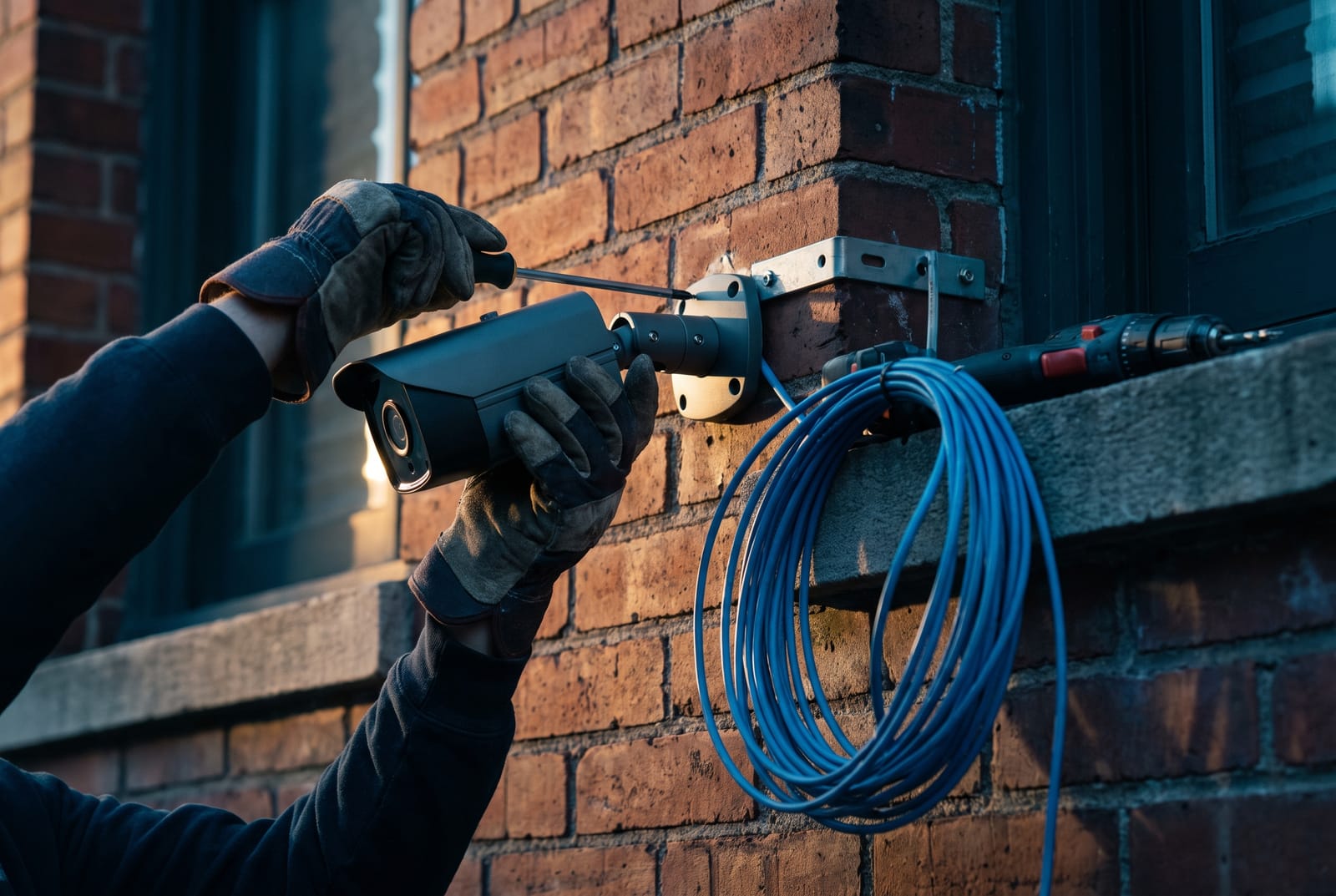
What works instead: the lens between eight and ten feet, on a wall or a post, aimed across the path somebody walks rather than down onto it, so a face crosses the frame at close to eye level. One camera positioned that way at the driveway pinch point, where the walk meets the apron, is worth three at roof height. Add a doorbell-height station at the front door for the face at the door, and a wider camera high up for context and vehicle movement. Coverage and identification are two different jobs and one camera rarely does both.
The side door is the target. On a Staten Island house the door off the driveway sits behind the fence line, out of sight of the street and of the neighbor, sheltered by the garage wall. It is the one that gets forced and the one that is usually covered by nothing. It deserves the best camera on the property and a contact that tells you it is standing open.
Two field details that decide whether the night image is usable. White vinyl siding and white soffit directly in front of a camera bounce its own infrared straight back into the lens and wash the frame out. The fix is aiming and separation, not a brighter illuminator. And infrared attracts insects, which attract spiders, which build webs across the housing and trigger motion recording all night; a camera you can actually reach to wipe twice a year is worth more than one mounted where it will never be touched again.
Six things about a detached house that change the design
None of these come up in an apartment building, and all of them come up here.
- The detached garage needs cable, not optimism. Wireless cameras across a yard, through a brick house wall and a garage wall, drop frames and then drop out. The reliable answer is a buried or aerial run to the garage. If that run is copper it ties the two structures’ electrical systems together and needs bonding and surge protection at both ends; a fiber link carries no metal and removes the problem, which on an exposed lot is the difference between a system that survives a storm season and one that does not.
- The overhead door is the door people leave open. A controller that reports open or closed state and can shut the door remotely solves more real incidents on this island than any camera does. And its safety reversing eyes are a monitored safety device in their own right. When a garage door refuses to close and reverses every time, that is almost always a misaligned or dirty eye, not a dead opener.
- The service door beside the garage is usually a hollow slab with a knob lock. Whatever is protecting the overhead door is irrelevant if that one opens with a shoulder. It needs a proper lock set, a contact, and a camera that sees the approach.
- Attached townhouse rows share a rear path. In Great Kills, Eltingville, Annadale, Arden Heights and Woodrow the back yards run in a continuous line with shared access between them. A camera covering your rear slider is also covering your neighbor’s back door, so mounting angle, height and privacy masking are part of the design rather than an afterthought.
- The 328-foot rule applies here too. A camera or reader powered over Ethernet must be within 100 meters of cable from the switch, and on a deep lot with a garage at the back and a gate at the road that limit arrives faster than people expect. It is solved with a mid-span or a fiber leg, but it has to be designed in, not discovered on install day.
- Boats, trailers and RVs at Great Kills Harbor. Seasonal storage on a side yard or a marina slip is a different camera problem: long, dark, unattended, and looking at a hull rather than a face. Plate capture at the gate and a lit approach do more than more lenses aimed at the boat.
Flood zone equipment siting: Midland Beach, Ocean Breeze, New Dorp Beach, Oakwood Beach, Tottenville
The default place to put a recorder is the basement utility wall next to the panel. On the east and south shores that is the worst place available. Put the recorder and its power supply above the base flood elevation for the property (a first-floor closet, a shelf, an interior wall well above the last high-water line), and terminate exterior camera runs above the flood line too.
The reason is not just the obvious one. A network connector that sits in salt water and is then dried out does not fail that day. It corrodes internally and fails intermittently three to nine months later, which is exactly when the system is trusted and nobody connects the symptom to the storm. The same goes for backup batteries left in a basement cabinet: after immersion they are scrap, whether or not they still light up.
None of this costs meaningful money at install. All of it costs a full system replacement if it is skipped.
What you are legally allowed to record
Outdoors, cameras on your own property that see part of a street or a neighboring yard are ordinary. Even so, masking the neighbor’s windows and door in the camera’s own settings is free, takes two minutes, and prevents most of the disputes we get called into. On a townhouse row where rear yards run together it is not optional in practice; it is what keeps a security system from becoming a boundary argument.
Audio is different and it is where people get into real trouble. New York is a one-party consent state for recording a conversation you are part of. An unattended microphone on a driveway or doorbell camera recording a conversation between two other people is a different thing entirely: eavesdropping under New York Penal Law § 250.05 is a class E felony. Our default on exterior residential cameras is that the microphone is disabled unless there is a specific, lawful reason to run it, and we say so in writing at handover.
For the commercial corridors (the South Shore BID at roughly 316 businesses, New Dorp Lane at 157, Forest Avenue at 149 and the West Shore at 72, plus the Staten Island Mall, the Hylan Boulevard and Richmond Avenue spines, the Teleport and the Howland Hook Marine Terminal), there are hard prohibitions to know. New York law bars cameras in fitting rooms, restrooms, showers and hotel rooms, and separately bars video recording of employees in restrooms, locker rooms and changing rooms. Those are not judgment calls and no business reason overrides them.
One more boundary worth stating plainly: we do not do monitored burglar alarm service, fire alarm work, line-voltage electrical or locksmithing. Cameras, access control, cabling and networks are ours; a central-station contract, a rekey or a new circuit belongs to someone holding a different license, and we will tell you who to call rather than take the work.
Staten Island neighborhoods we work in
Twelve ZIP codes cover the entire borough, 10301 through 10314.
North Shore
22 areas areas- St. George
- New Brighton
- Tompkinsville
- Stapleton
- Clifton
- Rosebank
- Shore Acres
- Arrochar
- Grymes Hill
- Silver Lake
- Randall Manor
- West New Brighton
- Port Richmond
- Elm Park
- Mariners Harbor
- Graniteville
- Westerleigh
- Castleton Corners
- Meiers Corners
- Sunnyside
- Park Hill
- Fox Hills
Mid-Island and the East Shore
22 areas areas- Bulls Head
- New Springville
- Heartland Village
- Willowbrook
- Manor Heights
- Todt Hill
- Emerson Hill
- Lighthouse Hill
- Egbertville
- Grasmere
- Dongan Hills
- Old Town
- Grant City
- New Dorp
- Midland Beach
- South Beach
- Ocean Breeze
- Oakwood
- Richmondtown
- Travis
- Bloomfield
- Chelsea
South Shore
14 areas areas- Greenridge
- Bay Terrace
- Great Kills
- Eltingville
- Annadale
- Arden Heights
- Huguenot
- Woodrow
- Rossville
- Prince’s Bay
- Pleasant Plains
- Richmond Valley
- Charleston
- Tottenville
Common questions
We’re in Midland Beach. Where should the recorder go?
Not in the basement. Put the recorder, its drive and its power supply above the base flood elevation for your property (a first-floor closet or a high shelf on an interior wall), and bring the camera cabling to it above the flood line rather than dropping it into a basement termination.
If the recorder is already downstairs, moving it is usually a short job and worth doing before the next storm rather than after. And if you have equipment that was submerged during a previous event and dried out, treat it as living on borrowed time: corroded connectors and drives fail intermittently months later, and diagnosing that after the fact costs more than the replacement would have.
Do we need a driveway gate, or is that overkill?
On most Staten Island lots it is overkill, and we will say so. Gates make sense on the larger properties (Todt Hill, Emerson Hill, Lighthouse Hill, parts of the South Shore) where there is a real setback. On a standard forty-foot lot there is usually no run-back for a slide gate and no clearance through the arc for a swing gate on a driveway that rises toward the house, and the controls have to sit at least six feet from the gate anyway, which puts a pedestal somewhere most owners do not want it.
What does the same work for far less: a keypad or fob reader at the side door, a controller on the overhead garage door that reports whether it is open, and a properly positioned camera on the apron. If you do want a gate, the operator carries safety obligations (two independent entrapment protection devices per direction of travel, monitored so the gate refuses to move when one is faulty), and the gate structure itself has to comply separately from the operator. We assess both before quoting.
Can I put a camera on my driveway if it can see my neighbor’s house?
Generally yes for the video. A camera on your property that incidentally takes in part of a street or an adjoining yard is normal, and there is no New York statute that makes it unlawful outdoors. What we do as standard is apply privacy masking over a neighbor’s windows and door inside the camera’s own configuration, so those areas are blacked out in both live view and recording.
Audio is the part to be careful with. Recording a conversation you are taking part in is lawful in New York, but leaving a microphone running on an exterior camera that captures other people’s conversations is eavesdropping, and that is a felony offense, not a civil matter. We disable microphones on exterior residential cameras by default. If you want audio somewhere specific, we will talk through whether it is lawful in that spot before enabling it.
Do you install intercoms here at all?
Rarely, and honestly it is usually the wrong product for this borough. Multi-tenant entry systems solve a problem that ten percent of the housing stock here has. In a single-family house a video doorbell station with a proper wired power feed does everything an intercom would, and does it better.
The exceptions are real, though: the small apartment buildings along Bay Street, Victory Boulevard and the north shore; two-family houses with a separate ground-floor unit; and the handful of larger residential properties in Stapleton, Clifton and St. George. Those are conventional multi-unit entry jobs and we do them the same way we would in Brooklyn.
Can you connect the cameras to an alarm company or call the police automatically?
We install and configure the cameras, the recording, the notifications to your phone, and remote access for you and whoever you nominate. What we do not do is central-station monitoring or monitored burglar alarms. That is a separately regulated activity and it is not our trade.
Where you already have an alarm company, we will coordinate so the two systems live together sensibly: shared door contacts where that makes sense, camera clips available when an event fires, and no duplicated sensors on the same opening. And where you do not have one and want one, we will tell you what to ask them for so you are not sold a second camera system on top of the one you just paid us to install.
Work that usually comes with this
Security Camera Installation
New IP camera systems for buildings, storefronts, offices and homes.
Gate & Parking Access Control
Vehicle gates, garage doors, parking control and the loops and safeties that go with them.
WiFi & Access Point Installation
Commercial wireless and building-wide coverage that survives brick and lath walls.
Security Camera Repair & Upgrades
Systems that stopped recording, cameras that went dark, analogue-to-IP migration.
Private Homes
Townhouses, brownstones and single-family homes on Long Island and in Westchester.
Small Business & Retail
Storefronts, bodegas, salons and offices: cameras, buzz-in entry and back-of-house control.
Walk the property with us.
Half an hour on the lot (driveway, side door, garage, yard, where the cable can actually run) and you get a written scope with camera positions marked. No charge, anywhere on the island.
Sun to Thu 9am to 5pm · Fri 9am to 12pm · Sat closed