A doorbell camera gives you a hood and a shoulder.
It is mounted at chest height, wide enough to see a porch, and it wakes up after motion has already started. For the two things homeowners most want, a face and a plate, it is the wrong camera in the wrong place.
A brownstone and a Levittown ranch are not the same install
We work both, and almost nothing carries over except the design thinking. The physical constraints are opposites.
A New York row house (brownstone, limestone, brick, two-family or single) has the install geometry that defines this city: a stoop, an outer vestibule door, and an inner parlor door a few feet behind it. That double-door arrangement is why entry work here is really intercom work rather than lock work, and it is why the camera position that matters is under the entry cornice looking down the stoop, not on the parlor door. Behind the walls there is plaster over wood lath, no conduit, and often no pathway at all between floors that is not already occupied by a hundred years of accumulated wiring. Opening a wall in a pre-1960 building also brings lead-paint work practices with it, which is a real reason to find a route rather than make one.
A Long Island or Westchester detached house is the opposite problem, and easier in almost every respect. Nassau and Suffolk are overwhelmingly post-war owner-occupied stock (roughly 82 percent owner-occupancy in both counties) built between 1947 and 1970. Levittown alone was about 17,000 houses put up between 1947 and 1951, and something like 80 percent of that stock is still a modified version of the original Cape or ranch, now 75-plus years old. Split-levels are everywhere because they suited the grade changes left by the glacial moraine. What all of that shares is framed walls that actually fish, plus an unfinished basement and an accessible attic, which together turn most cable routes into a straightforward afternoon rather than an archaeology project.
The catch on Long Island and in Westchester is heat and distance instead. An attic in July is punishing and it is where half the runs go, which is a scheduling reality rather than an excuse. And detached garages, long driveways and outbuildings put real distance between things, which runs straight into the physical limit below.
The stoop, the vestibule and the landmark review
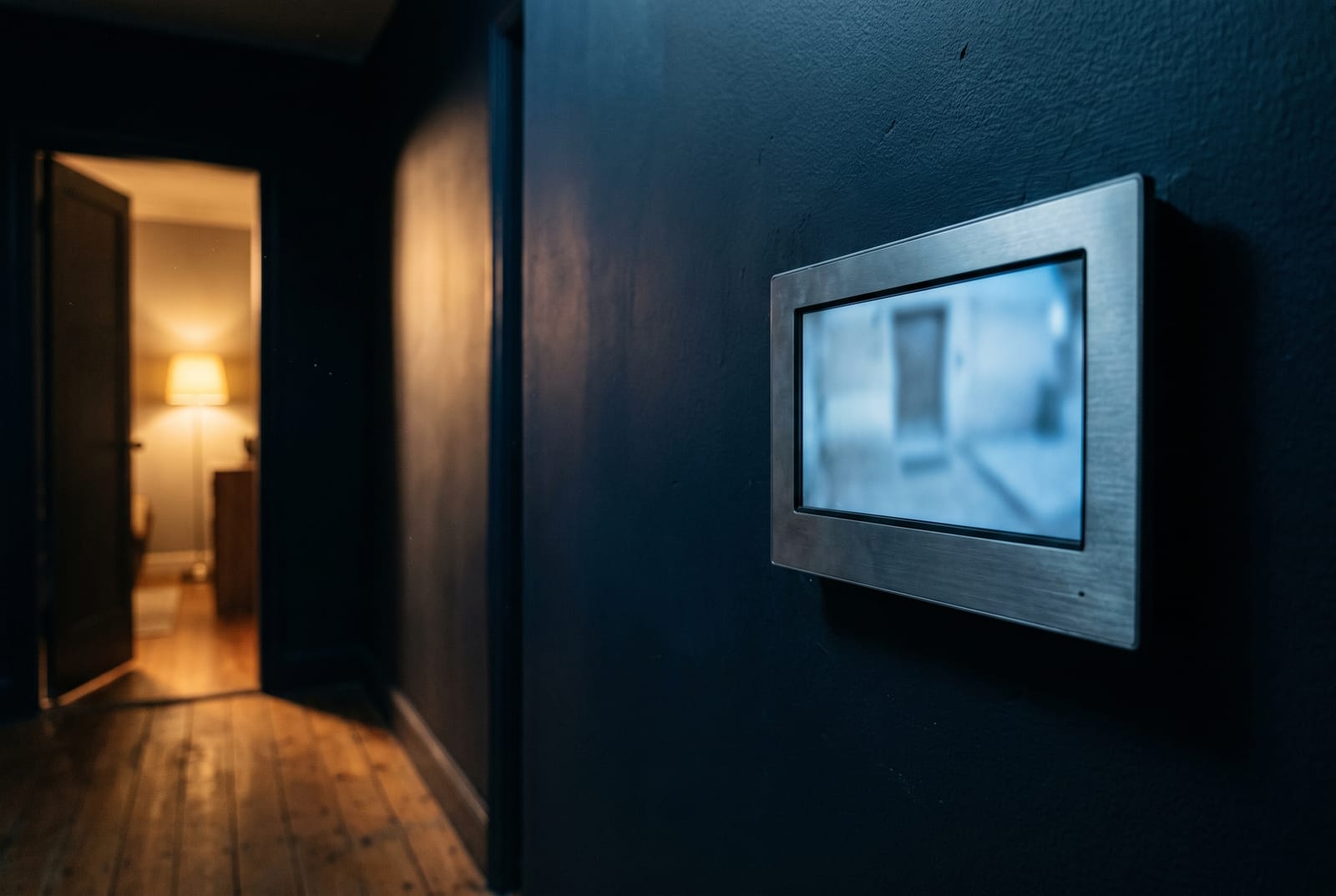
On a row house the entry system usually has to do three jobs at once: let a visitor call the house, let the house see and speak to them, and release the vestibule door. Where the house is two-family or has a rental garden apartment, add separate call buttons per unit, a separate garden-level entrance, and often a driveway-side or yard door.
The physical work is generally about finding a route rather than about the electronics. Between the vestibule and an upper floor there is frequently an existing pathway (an old bell wire, a redundant phone run, a gap beside a pipe chase), and finding it is worth an hour of survey, because the alternative is opening plaster in a public part of the house. Where a legacy pair exists, several two-wire video intercom systems can carry video and app access over it without opening anything, which is the single most useful retrofit capability in this housing stock.
Then there is the review layer, and in Brooklyn it applies to a remarkable share of the row-house stock: Brooklyn Heights (the city’s first historic district), Park Slope, Cobble Hill, Carroll Gardens, Boerum Hill, Fort Greene, Clinton Hill, Stuyvesant Heights, Crown Heights North, DUMBO, Prospect Lefferts Gardens and Ditmas Park, plus Greenwich Village, SoHo, Tribeca, the Upper East and West Sides, Mount Morris Park and Riverdale’s Fieldston. Anything visible from the street on a designated facade (a faceplate, a camera housing, surface conduit, an exterior reader, a change to entry door hardware) needs Landmarks review before a Buildings filing, and on a corner lot the side elevation counts as well.
Practically, work that stays inside the existing opening and matches the existing finish has a much easier path than a larger plate or new surface-mounted raceway. If your modern panel is physically bigger than the hole the old one left, that gap is the entire conversation, and it is worth resolving before anything is ordered.
What actually decides a Long Island or Westchester job
Five constraints that come up on nearly every detached-house survey, and none of which appear in a consumer product description.
- Ethernet over copper stops at 100 meters. About 328 feet, including the patch cords at both ends. A camera at the end of a long Bedford or Old Westbury driveway, or on a detached garage across a wide lot, is past it. The answers are fiber to a small enclosure out there, or a properly engineered wireless link, not a longer cable, which will work on a mild day and drop in August.
- A run between two structures wants fiber for a reason beyond distance. Copper between a house and a detached garage or gatehouse ties their electrical grounds together and gives a nearby lightning strike a path through your equipment at both ends. Fiber is immune to that, and on a property with outbuildings it is usually the cheaper decision over five years.
- The driveway crossing is the real cost, not the camera. Getting a cable under a paved driveway means a bore or a saw cut, and that is a different trade and a different number. Where an existing conduit or a soft route exists, the same camera costs a fraction. This is the first thing we look for on a survey and the item most likely to change the price.
- Gates carry legal obligations that fall on the installer. Two entrapment protection devices for each entrapment area in each direction of travel; monitored photo eyes and edges since 2016, which is why a gate refuses to move when an eye is dirty or misaligned; controls at least 6 feet from the gate; sliding gates screened from the bottom to at least 72 inches above grade; warning signs on both sides. And the gate itself is governed by a separate standard from the operator: an operator can be fully compliant on a gate that is not.
- Flood exposure changes where equipment gets mounted. On the south shores and in the post-Sandy zones (and in any basement that has taken water), the recorder, the power supplies and the low-voltage terminations belong above the base flood elevation, not on the basement wall where the cable happens to arrive. This costs almost nothing at install and is unrecoverable afterwards.
What a doorbell camera can and cannot do
| What people expect | What actually happens | What fixes it |
|---|---|---|
| A clear face | The unit sits at roughly chest height with a wide lens, so a person looking down or wearing a hood presents a hat and a shoulder. The pixels are spread across a whole porch | A second camera at head height across the approach, framed on the path rather than the door, with a narrower field of view. That is the camera that produces an identifiable image |
| Recording from the moment someone arrives | Battery models sleep and take a moment to wake and start recording, so the first seconds are missing. Someone who walks up, takes a box and leaves is often already turning away when recording begins | A continuously recording wired camera. Pre-roll buffering on some models helps; continuous recording removes the problem entirely |
| Reliable operation in winter | Battery chemistry loses capacity in the cold, so battery units record less and recharge slowly through a New York January, exactly the season with the highest delivery volume | Hardwired power. If a doorbell unit is the choice, wire it rather than run it on the battery |
| Night footage of the street | The unit’s own infrared lights the porch and blows out anything close, while the street stays black. Aimed through a storm door or glass panel, the infrared reflects back as a white sheet | Infrared off for anything shooting through glass, plus real exterior lighting. A lit approach improves every camera you own more than any sensor upgrade |
| Getting the package back | A clip is evidence for a police report. It is very rarely a recovery | A locked parcel box or a building-side receiving arrangement. If recovery is the goal, the fix is physical: the camera documents, it does not deter reliably |
We install and service doorbell cameras and they are a reasonable product. This table is about matching expectations to physics, because the gap between the two is where most homeowner disappointment lives.
Your neighbor’s yard, and the microphone
Attached and semi-detached houses (Queens row blocks, Bay Ridge, Staten Island’s townhouse subdivisions, and most of the city’s two-family stock) share party walls and rear-yard access paths. A rear camera aimed to cover your own yard will very often include some of your neighbor’s, and that is a dispute you will lose socially even where it is perfectly legal. Privacy masking, a fixed blanked region in the image, is set at commissioning, and we would rather set it on day one than be asked to after a conversation over the fence. It is also worth pointing the camera along your own boundary rather than across it wherever the geometry allows; you usually get better coverage of the access path that way anyway.
The microphone is the other one, and it is genuinely a legal question rather than a courtesy. New York permits recording a conversation with one party’s consent, but a camera on a wall is not a party to anything. An unattended microphone capturing a conversation between two other people has nobody consenting, and eavesdropping is a class E felony under Penal Law §250.05. A doorbell camera on a stoop, in a city where people stand and talk on stoops, is exactly where that happens by accident. Consumer devices ship with audio on. We turn it off unless there is a specific reason to leave it on, and we tell you what that reason has to look like.
One more scope note so there is no misunderstanding. We are not a monitored alarm company: we do not provide central-station monitoring, we do not do burglar alarm service, and we do not do fire alarm work or line-voltage electrical connections. What we install is cameras, entry and intercom systems, door and gate control, and the cabling and wireless underneath them, installed to be usable by you and administrable by you, with no account held in our name.
Common questions
Is a doorbell camera enough on its own?
For seeing who is at the door in real time and getting a rough record of deliveries, it is genuinely fine and we install them. For producing an image somebody could be identified from, it usually is not, because of where it is mounted and how wide its lens is. Chest height plus a wide field means a face occupies a small part of the frame and is often shaded by a hood or a hat brim.
The upgrade that changes the outcome is not a better doorbell. It is one additional camera at head height, positioned across the approach and framed on the path rather than on the door, with a narrower field of view so the pixels concentrate on a person rather than a porch. On a stoop that is often a small camera under the entry cornice; on a suburban house it is usually on the garage face looking back at the walk.
Two cameras chosen for two different jobs will outperform four cameras all doing the same one, and it is normally cheaper too.
Our block is a historic district. What can we actually put on the front?
More than most homeowners assume, provided it goes through review first. Anything visible from the street on a designated facade needs Landmarks approval before a Buildings filing, and most entry and camera work falls under the two lighter permit routes rather than a full hearing.
What tends to get approved: equipment mounted within an existing recess or under an existing cornice or canopy; finishes matched to the surrounding material; a panel that fits within the opening the previous one left; cable routed through existing penetrations. What tends to cause trouble: a larger faceplate than the original opening, new surface-mounted conduit on the facade, and anything that reads as an added object on original stone or ironwork. On a corner house the side elevation is reviewed too, which catches people out.
The practical advice is to settle the physical size and finish before choosing a product. Picking a panel first and then discovering it is two inches wider than the existing opening is how these projects lose a month.
We have a long driveway with an automatic gate. What actually goes wrong with them?
Three things, in this order. First, the safety devices. Since 2016 photo eyes and contact edges are monitored by the operator, so a lens fouled with pollen or road film, a bracket knocked by a delivery truck, water in a connector or a cut wire will stop the gate dead. That is the operator refusing to move because it cannot prove it will not close on someone. It is working correctly, and it must not be bypassed.
Second, power and connectivity at the gate. A gate 200 feet from the house needs power out there and, if it has an intercom or a camera, a data path. That is the real cost of a gate project and it is what a survey is establishing. Copper Ethernet will not reach past about 328 feet, and copper between two structures invites surge damage. On a long driveway, fiber is usually the right call.
Third, the gate itself as opposed to the operator. There is a separate standard governing gate construction (protrusions, gaps, climbability), and an operator can be fully compliant on a gate that is not. If we survey and find that, we will tell you in writing before quoting an operator, because automating a non-compliant gate moves a maintenance issue into a liability one.
Can we get a camera to the detached garage without digging up the driveway?
Sometimes, and it is worth twenty minutes on the survey to find out. The routes that avoid a trench, roughly in order of how often they work: an existing conduit put in for garage power or an old landscape lighting circuit; a soft route around the driveway edge through a garden bed rather than under paving; an overhead run where one already exists between structures; and a point-to-point wireless link with the camera powered locally at the garage.
Wireless is the fallback rather than the first choice, and we would rather be honest about why. It depends on line of sight, it degrades in heavy weather, and it needs power at the far end anyway, so it removes the data trench, not the electrical one. Where a garage already has power, that is often exactly the right trade.
If none of those exist, the crossing is a bore or a saw cut, and that is a real number that belongs in the quote before you commit rather than as a discovery afterwards.
Do you monitor the system, or call the police?
No. We are not a monitored alarm company and we do not provide central-station service. What we install sends notifications to you and to whoever else you choose, and records to equipment you own or to a platform registered in your name.
For plenty of households that is the right arrangement: a phone alert with a clip attached, from a system nobody is paying a monthly fee to watch. Where you genuinely want a monitored intrusion alarm with a dispatch response, that is a separate licensed service and we will say so and point you to it rather than pretend our scope covers it.
What we do build into every job is the assumption that nobody is watching. Recording is continuous or event-based rather than dependent on someone noticing; notifications go to more than one person; and analytics that distinguish a person from a car from a branch moving in the wind do the filtering, so the alerts you get are few enough that you still read them in month six.
Our neighbor is unhappy about a camera on the rear of the house. What are our options?
Start with the framing rather than the argument. In most cases a rear camera can be repositioned along your own boundary instead of across it and still cover the access path you care about, often better, because a camera looking along a fence line sees anyone moving down it, while one looking across a yard sees a small figure in the middle distance.
Where the geometry genuinely forces some of a neighbor’s property into the frame, privacy masking blanks that region permanently in the recorded image, not just in the live view. We set it at commissioning and note it in the handover so it is documented rather than something you have to demonstrate later. It is a small thing that has resolved a number of these conversations.
And keep the microphone off, which we do by default anyway. Audio is what turns a neighbor’s objection from a preference into a legitimate grievance, and it adds nothing you need.
Work that usually comes with this
Security Camera Installation
New IP camera systems for buildings, storefronts, offices and homes.
Video Intercom Systems
See who's at the door: lobby panels with cameras, in-unit monitors and phone apps.
Gate & Parking Access Control
Vehicle gates, garage doors, parking control and the loops and safeties that go with them.
WiFi & Access Point Installation
Commercial wireless and building-wide coverage that survives brick and lath walls.
Structured Cabling
Cat6/6A and fibre backbones, racks, patch panels, certified and labelled.
Small Business & Retail
Storefronts, bodegas, salons and offices: cameras, buzz-in entry and back-of-house control.
Tell us the house and what worries you.
Row house or detached, how many doors, whether there is a driveway or a gate, and what happened that started this. We’ll survey it and price it properly.
Sun to Thu 9am to 5pm · Fri 9am to 12pm · Sat closed