The product does not walk out the front door.
A restaurant loses inventory through the delivery entrance at 6 a.m., the dry storage door during a rush and the liquor room between services. Almost none of it is visible from the camera pointed at the dining room.
Six doors, and what each one is telling you
Restaurant security is a back-of-house problem wearing a front-of-house budget.
Ask an operator where their cameras are and the answer is usually the dining room, the entrance and the bar. Ask where the loss is and the answer is the walk-in, dry storage, the liquor room and the alley door. The two lists barely intersect, and that mismatch is why so many restaurants have a full recorder and no idea what happened to a case of tequila.
The six openings that matter in almost every New York restaurant: the delivery or cellar entrance, the walk-in cooler door, dry storage, the liquor room or cage, the office and safe, and the staff entrance. Five of those are back of house and four of them are usually unlocked because someone is carrying something with both hands.
The single most useful device in that list is not a camera. It is a door position switch, a magnetic contact reporting whether the door is open or closed. Without one you cannot generate a held-open alarm, and a held-open alarm is what tells you the alley door has been propped for forty minutes every morning since March. This is the classic finding when we walk a restaurant that already “has a system”: cameras on everything, contacts on nothing, and a service door that has been open half the year with nobody aware of it.
The second most useful thing is putting the walk-in door on camera rather than the walk-in interior. A camera inside a cooler fights condensation, temperature cycling and a lens that fogs every time the door opens. A camera on the corridor outside, framed at head height on the door, tells you who went in, what they were carrying and what they came out with, which is the actual question.
Grease, heat and steam kill hardware faster than vandals do
A commercial kitchen is the most hostile place in an ordinary building for electronics, and it fails equipment in a specific, predictable way. Aerosolized cooking oil settles on every surface within range of a hood, including the outside of a camera dome. Within a few months that film diffuses the image; within a year, with the camera’s own infrared illuminators bouncing off it, the picture at night is a white haze.
Dirt on the dome is the most common single cause of unusable night footage anywhere, and no camera reports its own dirt. So the design question in a kitchen is not which camera, it is: can somebody actually clean this without a ladder and a shutdown? A dome that requires a step ladder in a live line during service will never be cleaned. One reachable from a fixed point at the end of a shift will be.
Three practical specifications follow. First, anything in a washdown zone needs an ingress rating that assumes water jets or immersion, not splash. A kitchen floor gets hosed, and a camera at low level near a prep sink gets hit. Second, the housing wants to be stainless or a finish that survives degreaser, because repeated cleaning with kitchen chemicals will fog and craze a cheap polycarbonate dome inside a year. Third, keep cameras out of the hood’s immediate area entirely where the layout allows: the useful shots in a kitchen are the doorways and the pass, not the range.
Cable takes the same beating. A run through a kitchen ceiling void shares that space with grease-laden air, and terminations near a dish pit corrode. This is a place where the extra cost of a better-jacketed cable and a properly sealed enclosure returns itself, because the failure is not dramatic: it is a camera that goes intermittent in eighteen months and takes half a day to trace.
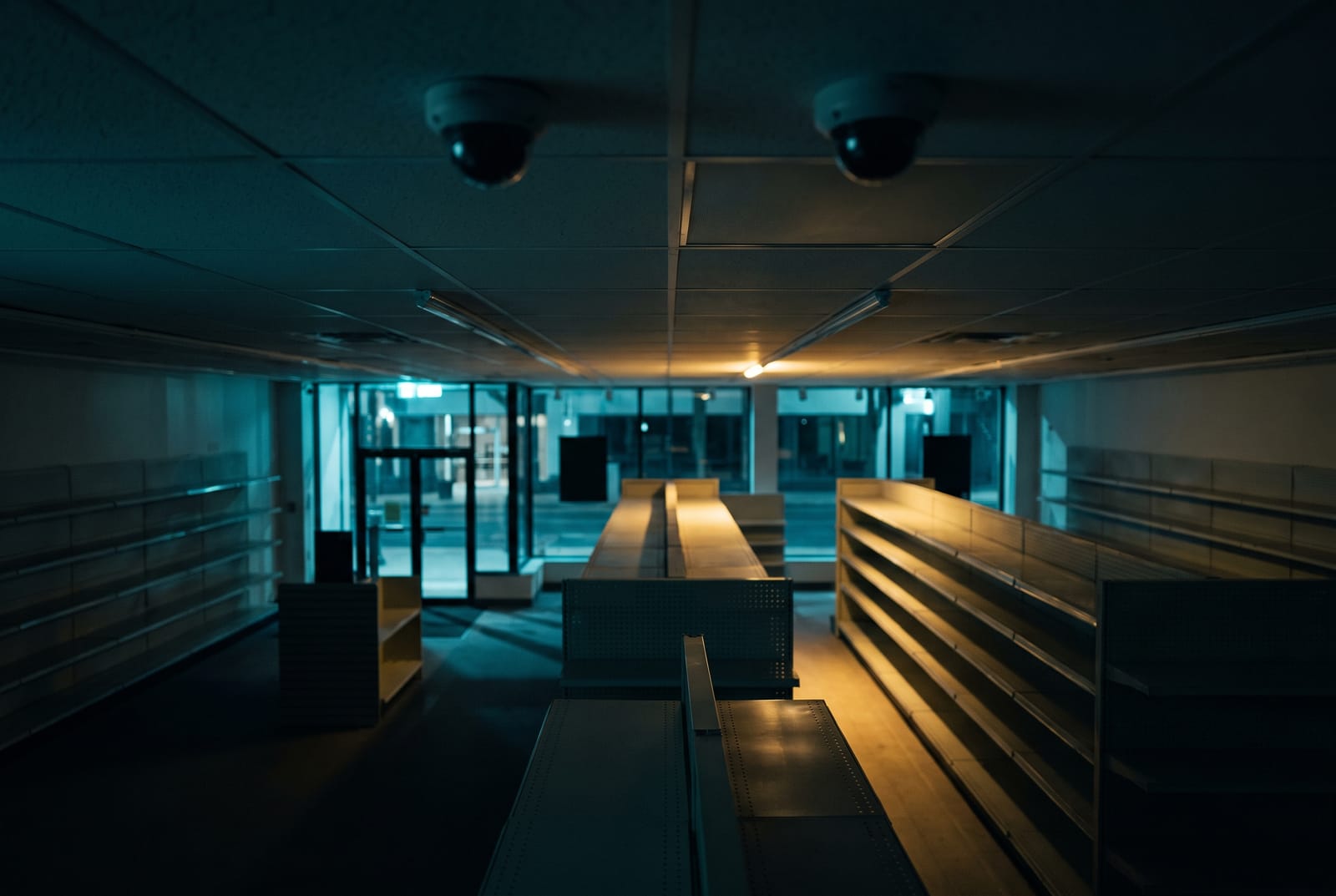
Positions that pay for themselves, and how to frame them
| Position | Frame it on | The mistake we find |
|---|---|---|
| Point of sale | The open drawer and the hands, filling most of the frame. Not the server, not the room | Mounted high and wide so it captures the transaction as three small figures. Useless for a void or no-sale review |
| Bar well and speed rail | The pour and the register, at an angle that shows both the bottle and the ticket | Placed behind the bartender, which shows a back and a shoulder for the whole shift |
| Safe or count room | The dial or keypad and the hands at the moment of opening | Mounted above and behind the person, so every count is filmed from the one angle that shows nothing |
| Delivery or cellar entrance | The threshold at head height, plus what is being carried through it | Aimed down the alley for context, so the actual doorway is at the edge of the frame |
| Walk-in and dry storage doors | The corridor and the door, head height | Mounted inside the cooler, where it fogs, ices and sees nothing useful |
| Staff entrance and locker area | The doorway only, never a changing area | Coverage creeping into a space where recording employees is prohibited. Draw the line at the door frame and stay behind it |
Framing matters more than resolution on every line of this table. A 4 MP camera correctly framed on a drawer beats an 8 MP camera framing the room.
Why credentials, not locks, are the actual return on investment
Restaurant staff turnover is the highest of any vertical on this site. That single fact should drive the hardware choice.
- A key that walks is a rekey. A credential that walks is a click. Rekeying a back door in New York means a locksmith, a callout and new keys for everyone who legitimately holds one. Revoking a fob is a browser tab and ten seconds, done by a manager. Across a year of ordinary turnover that difference is the entire cost of the system several times over.
- Do not put a legacy proximity fob on the liquor room. Old 125 kHz credentials transmit a fixed number with no encryption; a twenty-dollar handheld duplicator copies one in about fifteen seconds, and consumer kiosks in supermarkets now do it for a few dollars. If a credential controls something worth stealing, it needs to be an encrypted 13.56 MHz card or a phone credential.
- Phone credentials solve the collection problem. Nobody returns a fob on their last shift. A mobile credential is revoked from the same screen as the schedule, and there is nothing physical to chase. The trade-off is honest: it depends on staff having a working phone and on the reader having power and connectivity, so keep a mechanical override and a documented fallback for the day the network is down.
- Log the door, not just the lock. A credential event tells you a valid card was presented. A door position switch tells you whether the door actually opened, how long it stayed open, and whether it opened without any credential at all. The second one is where the useful reports come from.
- Give managers the console, not the contractor. If adding a new hire’s access requires a service call, it will be handled by lending someone else’s fob instead, and your access log becomes fiction. The system has to be administrable by whoever is running the shift.
Three legal lines in a restaurant, stated plainly
Never lock an exit. A dining room or bar is an assembly space, and the exit doors have to open from the inside with one motion, without a key, a code or special knowledge. Delayed-egress hardware, the kind that alarms and holds for fifteen seconds, is not permitted in assembly occupancies under the model code, and a delayed-egress arrangement anywhere requires full sprinkler or detection coverage in the building. The correct answer for a rear door that keeps getting propped is an alarmed contact and a door-held-open report, not a lock.
Audio off by default. New York is a one-party consent state, but an unattended microphone recording a conversation between two guests has no consenting party, and eavesdropping is a class E felony under Penal Law §250.05. A bar is exactly the environment where that happens by accident. Cameras go in with microphones disabled unless there is a documented reason and posted notice. Separately, no cameras in restrooms under GBL §395-b, and none where employees change clothes, under Labor Law §203-c.
Fingerprint time clocks are covered by the biometric signage law. New York City food-and-drink establishments that collect biometric identifier information must post a clear sign at every customer entrance under Admin Code §22-1201, and there is an absolute ban on selling or otherwise profiting from that data. If you run fingerprint clock-in, that sign is a requirement, not a nicety.
Common questions
A case of liquor disappears most weeks and the cameras never show anything.
Almost always because the cameras cover rooms and the loss happens at doors. Product does not evaporate in the middle of dry storage; it goes through an opening, usually inside something else: a trash bag, a linen bag, an empty case, a backpack at the staff door.
The sequence that actually solves this: put a contact on the liquor room, dry storage and the delivery door, and a camera at head height on the corridor outside each, framed on the threshold. Then look at the held-open and after-hours reports for two weeks before you look at any footage. The contact data tells you when to look; the footage tells you what happened. Trying to find it by scrubbing video first is how people give up.
The other common finding is that the liquor room is not actually locked during service because it slows people down. If that is true, no camera fixes it, and the honest answer is a credentialed door that opens fast for the people who need it and logs every entry, which is what access control is genuinely good at.
Can we put cameras in the kitchen? Will the health inspector object?
The constraint is not the inspector, it is grease. Cameras are ordinary equipment in a commercial kitchen and are widely installed. What actually decides whether it works is whether the housing survives degreaser and whether anyone can reach it to clean it.
Our rule of thumb: mount kitchen cameras where a person standing on the floor or a fixed step can wipe the dome at the end of a shift, keep them out of the immediate hood zone, specify a housing rated for washdown if it is anywhere near a hose or a prep sink, and expect to schedule cleaning rather than hope for it. A dome nobody can reach will be a fogged white circle within a year and the footage will be worthless exactly when you need it.
Where the camera is going into a ceiling void that shares air with a grease-laden environment, cable and enclosure selection matters too. That is a place where the cheap termination fails quietly at eighteen months.
Our turnover is high. What is the least painful way to handle keys?
Stop using keys for anything you will need to revoke. Keep mechanical keys for the front door and the landlord’s requirements, and move everything internal (office, liquor, storage, staff entrance) to credentials a manager can issue and remove from a browser.
Then set the expectation that revocation happens on the last shift, not on the following Monday, and make sure at least two managers can do it. The most common failure is that only the owner has the login, the owner is not there on the night someone is let go, and the credential stays live for a week.
Phone credentials are worth considering specifically because of the collection problem: there is nothing to hand back. Keep a mechanical override on every credentialed door regardless, because a restaurant cannot afford to be locked out of its own walk-in because the network is down.
The delivery door gets propped open every morning. Can we stop it?
You can measure it, alarm it, and make it inconvenient. In practice measuring it is what changes the behavior. Put a contact on the door and set a held-open threshold long enough to accept a real delivery, short enough to flag a door left open through the whole receiving window. Send that as a notification to the manager on duty rather than to a screen nobody watches.
Then look at why it is propped, because usually the answer is reasonable: someone is carrying cases with both hands and the door does not stay open on its own. A hold-open device on the closer, or a proper doorstop with a defined procedure, converts an uncontrolled propped door into a controlled one that closes when receiving ends. That is a better outcome than an alarm everybody learns to ignore.
What we would not do is put a lock on it that fights egress. If that door is in an exit path it has to open freely from inside, always.
Can we record audio at the bar for disputes?
We would advise against it and we ship cameras with microphones off. New York permits recording a conversation with one party’s consent, but a camera on a wall is not a party to anything. An unattended microphone capturing two guests talking has no consenting party, and that is a felony-level offense rather than a technicality.
For the disputes bars actually have (a contested charge, an over-service question, an incident at closing), the image and the timestamp do the work. Aligning camera time with your point-of-sale export is far more useful than audio and carries none of the exposure.
We are in the ground floor of a residential building. Does that change anything?
Quite a lot, and it is worth raising early. You are working under a lease and usually an alteration agreement with the building, which means the landlord or the board has a say in anything touching the facade, the common areas, the risers or the roof. Running a cable to a rear yard camera through the building’s cellar is a conversation, not a decision you make alone.
The second issue is separation. Your staff entrance often shares a corridor or a service door with the residential side, and the building will not want your credentials admitting people to their common areas or the reverse. That is solvable (separate systems, or one system with hard-partitioned door groups), but it has to be designed rather than discovered.
Third, noise and hours. House rules typically restrict drilling to weekday daytime hours, which collides directly with the fact that your own work window is after close. Expect to split the job: the noisy work in the building’s permitted hours, the front-of-house work overnight.
Work that usually comes with this
Commercial Security Cameras
Retail, restaurant, warehouse and office systems, including NDAA-compliant hardware.
Access Control Installation
Complete door-control systems, from a single door to a multi-building portfolio.
Key Fob Entry Systems
Fob-based building entry, plus the credential management that keeps it from becoming chaos.
Security Camera Installation
New IP camera systems for buildings, storefronts, offices and homes.
Small Business & Retail
Storefronts, bodegas, salons and offices: cameras, buzz-in entry and back-of-house control.
Door Buzzer Systems
Buzz-in entry for walk-ups, storefronts, offices and back-of-house doors.
Send us a floor plan or a napkin sketch.
Mark the delivery door, the walk-in, the liquor storage and where cash is handled. That’s enough for us to tell you what to put where and what it will cost.
Sun to Thu 9am to 5pm · Fri 9am to 12pm · Sat closed