Nine villages on one peninsula, and three completely different jobs
Great Neck is not one place. It is nine incorporated villages and several hamlets across a peninsula of about two and a half square miles, spanning ZIP codes 11020 to 11027, and the permit desk changes street by street.
Co-op towers, waterfront estates and a retail spine, all within two miles
The incorporated villages on the peninsula are Great Neck, Great Neck Estates, Great Neck Plaza, Kensington, Kings Point, Lake Success, Russell Gardens, Saddle Rock and Thomaston, with hamlets including University Gardens, Great Neck Gardens, Harbor Hills and Saddle Rock Estates. All of them are in the Town of North Hempstead. All of them have their own government, and several have their own building department.
Great Neck Plaza is the density: a concentration of mid-century co-op and rental apartment buildings clustered around the LIRR station and the Middle Neck Road professional and retail corridor. These are elevator buildings, frequently built between the 1950s and the 1970s, with an original lobby intercom, an original riser, a garage underneath and a board that meets monthly. That combination is the whole job description.
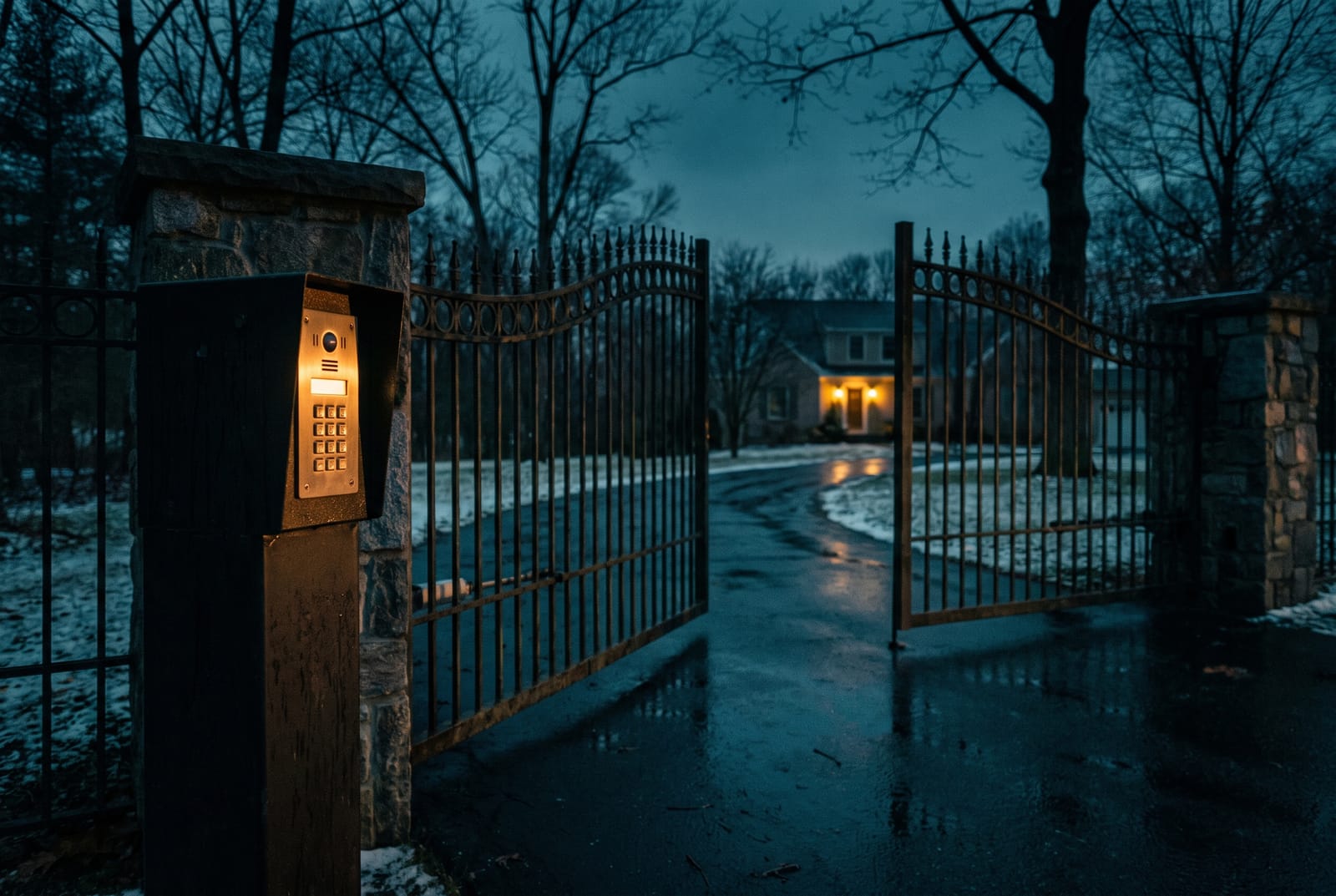
Kings Point and Saddle Rock are the other extreme. Kings Point has roughly 5,600 residents and average property values above $3 million; the waterfront lots run to the Sound with long driveways, gates, guest houses and detached garages. This is perimeter work: an operator and an entry station at the road, cameras framed for identification rather than coverage, and cable runs that will not fit inside a 328 foot Cat6 channel.
Lake Success adds a third: a corporate office park population with an entirely commercial set of requirements, sitting a few minutes from both of the above.
How a Great Neck co-op intercom replacement actually runs
The technical part is the easy part. The sequence is what determines whether the project happens this year or next.
- The riser survey happens before the board vote, not after. Ring out the riser, count usable pairs, check insulation condition, photograph everything. Until that is done the number in front of the board is a guess, and a guess that turns into a change order costs a managing agent far more than the survey did.
- The scope has to survive a board reading it. Exactly which hardware, exactly which doors, what is being reused, what is being replaced, what was found that is out of scope, and any genuine unknown named as an unknown with a capped allowance. Boards approve documents they understand and defer documents they do not.
- Shareholder notice and building access are the schedule. In-unit stations mean entering apartments, which means notices, a schedule that accommodates people who work, and a second pass for the units that were not home. Budget for the second pass; every building has one.
- Phasing beats a single shutdown. Lobby panel and head-end first with the old system still live, then in-unit stations floor by floor, then cutover. A building is never left overnight with no working entry system.
- Elevator floor restriction is a separate project with its own lead time. On a traditional cab, a reader goes in the car, its output runs down the traveling cable to a panel in the machine room, and relays enable only the permitted floors. Entry-level platforms run roughly one controller per four stops, so a fourteen-story building needs more hardware than people assume. The detail most integrators skip is bringing the floor-button outputs back as inputs, so the system logs which floor was actually chosen.
- Garage gates are governed hardware. UL 325 requires two entrapment-protection devices per entrapment area per direction of travel, and since 2016 the external ones are monitored: a faulted photo eye stops the gate entirely. On a residential garage with a single ramp, that is worth knowing before the first time it happens at 7 a.m.
Gate to house is usually further than the cable allows
On the Kings Point and Saddle Rock waterfront the constraint that decides the design is distance. A Cat6 channel carrying power over Ethernet is limited to 100 meters (328 feet including patch cords), and a driveway that routes around planting rather than running straight will pass that without feeling long.
The correct answer past that point is a small weatherproof enclosure at the gate with local power and a single-mode fiber leg back to the house, or an intermediate enclosure partway down. Fiber also removes the ground-potential difference between two structures on separate services, which is a genuine and frequently misdiagnosed cause of intermittent faults on a large property.
The second constraint is that a waterfront property on this peninsula is several buildings, not one. A main house, a detached garage, usually a guest house or pool house, and on the Sound side a dock with lighting and a camera nobody costed at design stage. Each is a separate structure on a separate feed, so each wants its own small switch in a protected enclosure and its own answer to what happens in a power cut. Scoping the property as a single building is how an owner ends up with a gate that works perfectly and a boathouse camera that has been dark since the first nor’easter.
If the gate still dials out over a copper phone line, that is a separate and very common problem out here. What happens to those panels when the copper goes away is covered on the Long Island page.
Common questions
Do we have to rewire the risers to get video entry in a 1965 co-op?
Frequently not, and that is the first thing we check. A great many buildings of this era have more conductors in the riser than anyone believes, left behind by an earlier system, and several current platforms are specifically designed to carry audio or even video over a small number of existing pairs.
Two technical details decide it. Bus-type systems are specified on 18 or 20 AWG with polyethylene insulation because ordinary PVC-jacketed cable has higher capacitance and degrades the bus, a classic failure when somebody uses whatever was on the truck. And where an older video system left coaxial cable in the riser, that coax can often be reused with Ethernet-over-coax converters rather than abandoned. On a bus system, distances of several hundred feet from the entrance to the furthest station are normal, so height is rarely the problem. Condition is.
Which village are we in, and does it matter?
It matters for permits and it is genuinely confusing here. Nine incorporated villages plus unincorporated hamlets share the peninsula and the Great Neck postal name, and the ZIP codes from 11020 to 11027 do not map cleanly onto village boundaries. Kings Point, Great Neck Estates, Great Neck Plaza, Kensington, Russell Gardens, Saddle Rock, Thomaston and Lake Success each have their own government; unincorporated areas fall to the Town of North Hempstead.
We confirm which authority covers your address before quoting anything that might need a filing, particularly a gate operator, since the electrical circuit feeding it is licensed electrical work handled by an electrician and some villages have their own requirements around gates, fences and setbacks.
How long does a full co-op intercom replacement take?
The physical work in a mid-size elevator building is usually a matter of days to a couple of weeks depending on unit count and how many apartments we can get into on the first pass. The calendar is dominated by everything around it: survey, written scope, board review, a board meeting that happens monthly, shareholder notice, and scheduling in-unit access.
Realistically, from first call to finished handover on a co-op is a season, not a week, and the largest single variable is how quickly the board meets. What we can compress is our part: the survey and the written scope inside a normal turnaround, so the document is ready for the next meeting rather than the one after it.
Can we restrict which floors a resident’s fob will reach?
Yes, and in a building with commercial space, a roof deck or a gym it is often the point of the project. On a traditional elevator bank a reader goes in each cab, wired down the traveling cable to a panel in the machine room, and the panel’s relays enable only the floors that credential is entitled to, for a timed window after the read.
Two things worth insisting on. First, feed the floor-button outputs back into the access system as inputs, so it knows which floor was actually selected and can log it. Most installations skip this and lose the audit trail that made the project worth doing. Second, ask the elevator company for a dry contact that closes when a car goes into fire service mode, and monitor it. Fire service keys are often common across every elevator of a given brand and are easy to buy, so knowing when a car has been put into that mode is worth having.
All elevator work is coordinated with your elevator maintenance company. We do not work inside their controller.
Our building has a garage under it. Can residents use one credential for everything?
That is the right goal and it is usually achievable, but the gate side has to be designed for it. The garage gate operator, the pedestrian door from the garage, the lobby and the elevator should all read the same credential from the same system, with different permissions attached. Where buildings end up with three credentials is when the gate was installed by one company on its own controller years before the access system existed.
Consolidating those is normally straightforward: the existing operator usually stays, and its input is re-fed from the access system rather than from a separate receiver. What is not negotiable is the safety hardware: the gate keeps its two entrapment-protection devices per direction, monitored, whatever the credential arrangement looks like.
Work that usually comes with this
Intercom Replacement & Upgrade
Replacing obsolete systems, including retrofits that reuse existing riser cable.
Elevator Access Control
Floor restriction for co-ops, condos and mixed-use buildings.
Co-ops & Condos
Board-vote timelines, shareholder communication, and phased work that doesn't blow the reserve fund.
Gate & Parking Access Control
Vehicle gates, garage doors, parking control and the loops and safeties that go with them.
Key Fob Entry Systems
Fob-based building entry, plus the credential management that keeps it from becoming chaos.
Video Intercom Systems
See who's at the door: lobby panels with cameras, in-unit monitors and phone apps.
Co-op board, or a house on the water?
Tell us which and we will tell you what has to happen first: usually a riser survey on one, a distance measurement on the other.
Sun to Thu 9am to 5pm · Fri 9am to 12pm · Sat closed